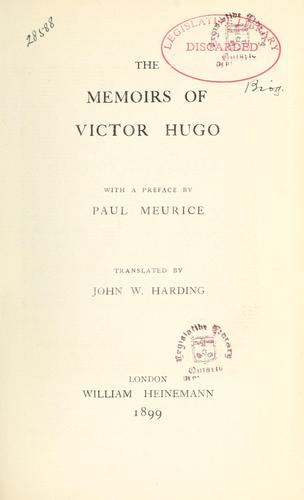
Authors, French -- 19th century -- Biography; Autobiographies; Hugo, Victor, 1802-1885
The Assembly roared with laughter, and the roar of laughter continued
throughout the remainder of his discourse. He called M. Landrin M.
Flandrin, and the gaiety became delirious.
I was among those whom this gaiety made heavy at heart, for I seemed to
hear the sobs of the people above these bursts of hilarity.
During this uproar a list which was being covered with signatures and
which bore an order of the day proposed by M. Dupont de l’Eure, was
passed round the benches.
Dupont de l’Eure, bent and tottering, read from the tribune, with the
authority of his eighty years, his own order of the day, amid a deep
silence that was broken at intervals by cheers.
The order of the day, which was purely and simply a reiteration of
the declaration of June 28: “General Cavaignac has merited well of the
fatherland,” was adopted by 503 votes to 34.
Mine was among the thirty-four. While the votes were being counted,
Napoleon Bonaparte, son of Jerome, came up to me and said:
“I suppose you abstained?”
“From speaking, yes; from voting, no,” I replied.
“Ah!” he went on. “We ourselves abstained from voting. The Rue de
Poitiers also abstained.”
I took his hand and said:
“You are free to do as you like. For my part I am not abstaining. I am
judging Cavaignac, and the country is judging me. I want the fullest
light thrown upon my actions, and my votes are my actions.”
1849.
I. THE JARDIN D’HIVER.
II. GENERAL BREA’S MURDERERS.
III. THE SUICIDE OF ANTONIN MOYNE.
IV. A VISIT TO THE OLD CHAMBER OF PEERS.
I. THE JARDIN D’HIVER. FEBRUARY, 1849.
In February, 1849, in the midst of the prevailing sorrow and terror,
fetes were given. People danced to help the poor. While the cannon with
which the rioters were threatened on January 29, were, so to speak,
still trained ready for firing, a charity ball attracted all Paris to
the Jardin d’Hiver.
This is what the Jardin d’Hiver was like:
A poet had pictured it in a word: “They have put summer under a glass
case!” It was an immense iron cage with two naves forming a cross, as
large as four or five cathedrals and covered with glass. Entrance to it
was through a gallery of wood decorated with carpets and tapestry.
On entering, the eyes were at first dazzled by a flood of light. In
the light all sorts of magnificent flowers, and strange trees with the
foliage and altitudes of the tropics, could be seen. Banana trees, palm
trees, cedars, great leaves, enormous thorns, and queer branches twisted
and mingled as in a virgin forest. The forest alone was virgin there,
however. The prettiest women and the most beautiful girls of Paris
whirled in this illumination _a giorno_ like a swarm of bees in a ray of
sunshine.
Public-domain text, read in full here on John Shaqi.
Reviews
Reviews
No reviews yet
Be the first to share your thoughts on this work.
Elsewhere in the archive
Join the Discussion
Join the discussion
Sign in to leave a comment or review.
Sign InorCreate an account