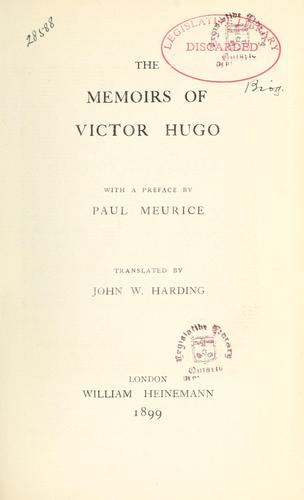
Authors, French -- 19th century -- Biography; Autobiographies; Hugo, Victor, 1802-1885
President Louis Bonaparte was inclined to be merciful. The revision and
cassation could easily have been delayed. The Archbishop of Paris,
M. Sibour, successor of a victim, had begged for their lives. But the
stereotyped phrases prevailed. The country must be reassured. Order must
be reconstructed, legality rebuilt, confidence re-erected! And society
at that time was still reduced to employing lopped heads as building
material. The Council of State, such as it then was, consulted under
the terms of the Constitution, rendered an opinion in favour of the
execution. M. Cresson, counsel for Daix and Lahr, waited upon the
President. He was an emotional and eloquent young man. He pleaded for
these men, for the wives who were not yet widows, for the children who
were not yet orphans, and while speaking he wept.
Louis Bonaparte listened to him in silence, then took his hands, but
merely remarked: “I am most unhappy!”
In the evening of the same day--it was on the Thursday--the Council of
Ministers met. The discussion was long and animated. Only one minister
opposed recourse to the scaffold. He was supported by Louis Napoleon.
The discussion lasted until 10 o’clock. But the majority prevailed, and
before the Cabinet separated Odilon Barrot, the Minister of Justice,
signed the order for the execution of three of the condemned men, Daix,
Lahr and Chopart. The sentences of Nourry and Vappreaux, junior, were
commuted to penal servitude for life.
The execution was fixed for the next morning, Friday.
The Chancellor’s office immediately transmitted the order to the Prefect
of Police, who had to act in concert with the military authorities, the
sentence having been imposed by a court-martial.
The prefect sent for the executioner. But the executioner could not be
found. He had vacated his house in the Rue des Marais Saint Martin in
February under the impression that, like the guillotine, he had been
deposed, and no one knew what had become of him.
Considerable time was lost in tracing him to his new residence, and when
they got there he was out. The executioner was at the Opera. He had gone
to see “The Devil’s Violin.”
It was near midnight, and in the absence of the executioner the
execution had to be postponed for one day.
During the interval Representative Larabit, whom Chopart had befriended
at the barricade of the barriers, was notified and was able to see the
President. The President signed Chopart’s pardon.
The day after the execution the Prefect of Police summoned the
executioner and reproved him for his absence.
“Well,” said Samson, “I was passing along the street when I saw a big
yellow poster announcing The Devil’s Violin. ‘Hello!’ said I to myself,
‘that must be a queer piece,’ and I went to see it.”
Thus a playbill saved a man’s head.
There were some horrible details.
Public-domain text, read in full here on John Shaqi.
Reviews
Reviews
No reviews yet
Be the first to share your thoughts on this work.
Elsewhere in the archive
Join the Discussion
Join the discussion
Sign in to leave a comment or review.
Sign InorCreate an account