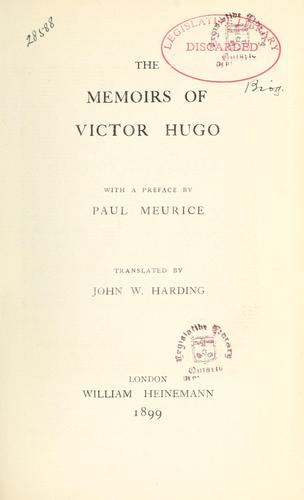
Authors, French -- 19th century -- Biography; Autobiographies; Hugo, Victor, 1802-1885
She rushed into the room her husband had entered, then recoiled in
horror. She had seen a body stretched upon the floor.
She ran wildly about the house screaming for help. But no one came,
either because everybody was out or because owing to the noise in the
street she was not heard.
Then she returned, re-entered the room and knelt beside her husband.
The shot had blown nearly all his head away. The blood streamed upon the
floor, and the walls and furniture were spattered with brains.
Thus, marked by fatality, like Jean Goujon, his master, died Antonin
Moyne, a name which henceforward will bring to mind two things--a
horrible death and a charming talent.
IV. A VISIT TO THE OLD CHAMBER OF PEERS. June, 1849.
The working men who sat in the Luxembourg during the months of March and
April under the presidency of M. Louis Blanc, showed a sort of respect
for the Chamber of Peers they replaced. The armchairs of the peers were
occupied, but not soiled. There was no insult, no affront, no abuse. Not
a piece of velvet was torn, not a piece of leather was dirtied. There is
a good deal of the child about the people, it is given to chalking its
anger, its joy and its irony on walls; these labouring men were serious
and inoffensive. In the drawers of the desks they found the pens and
knives of the peers, yet made neither a cut nor a spot of ink.
A keeper of the palace remarked to me: “They have behaved themselves
very well.” They left their places as they had found them. One only
left his mark, and he had written in the drawer of Louis Blanc on the
ministerial bench:
Royalty is abolished.
Hurrah for Louis Blanc!
This inscription is still there.
The fauteuils of the peers were covered with green velvet embellished
with gold stripes. Their desks were of mahogany, covered with morocco
leather, and with drawers of oak containing writing material in plenty,
but having no key. At the top of his desk each peer’s name was stamped
in gilt letters on a piece of green leather let into the wood. On the
princes’ bench, which was on the right, behind the ministerial bench,
there was no name, but a gilt plate bearing the words: “The Princes’
Bench.” This plate and the names of the peers had been torn off, not by
the working men, but by order of the Provisional Government.
Public-domain text, read in full here on John Shaqi.
Reviews
Reviews
No reviews yet
Be the first to share your thoughts on this work.
Elsewhere in the archive
Join the Discussion
Join the discussion
Sign in to leave a comment or review.
Sign InorCreate an account