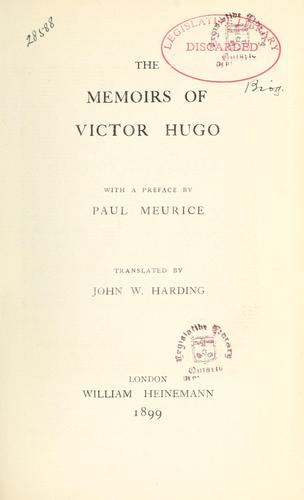
Authors, French -- 19th century -- Biography; Autobiographies; Hugo, Victor, 1802-1885
Prudhon was born in 1803. He has thin fair hair that is ruffled and
ill-combed, with a curl on his fine high brow. He wears spectacles. His
gaze is at once troubled, penetrating and steady. There is something
of the house-dog in his almost flat nose and of the monkey in his
chin-beard. His mouth, the nether lip of which is thick, has an habitual
expression of ill-humour. He has a Franc-Comtois accent, he utters the
syllables in the middle of words rapidly and drawls the final syllables;
he puts a circumflex accent on every “a,” and like Charles Nodier,
pronounces: “_honorable, remarquable_.” He speaks badly and writes well.
In the tribune his gesture consists of little feverish pats upon his
manuscript with the palm of his hand. Sometimes he becomes irritated,
and froths; but it is cold slaver. The principal characteristic of his
countenance and physiognomy is mingled embarrassment and assurance.
I write this while he is in the tribune.
Anthony Thouret met Prudhon.
“Things are going badly,” said Prudhon.
“To what cause do you attribute our embarrassments?” queried Anthony
Thouret.
“The Socialists are at the bottom of the trouble, of course.
“What! the Socialists? But are you not a Socialist yourself?”
“I a Socialist! Well, I never!” ejaculated Prudhon.
“Well, what in the name of goodness, are you, then?”
“I am a financier.”
BLANQUI.
Blanqui got so that he no longer wore a shirt. For twelve years he had
worn the same clothes--his prison clothes--rags, which he displayed
with sombre pride at his club. He renewed only his boots and his gloves,
which were always black.
At Vincennes during his eight months of captivity for the affair of the
15th of May, he lived only upon bread and raw potatoes, refusing all
other food. His mother alone occasionally succeeded in inducing him to
take a little beef-tea.
With this, frequent ablutions, cleanliness mingled with cynicism, small
hands and feet, never a shirt, gloves always.
There was in this man an aristocrat crushed and trampled upon by a
demagogue.
Great ability, no hypocrisy; the same in private as in public. Harsh,
stern, serious, never laughing, receiving respect with irony, admiration
with sarcasm, love with disdain, and inspiring extraordinary devotion.
There was in Blanqui nothing of the people, everything of the populace.
With this, a man of letters, almost erudite. At certain moments he
was no longer a man, but a sort of lugubrious apparition in which all
degrees of hatred born of all degrees of misery seemed to be incarnated.
LAMARTINE. February 23, 1850.
During the session Lamartine came and sat beside me in the place usually
occupied by M. Arbey. While talking, he interjected in an undertone
sarcastic remarks about the orators in the tribune.
Thiers spoke. “Little scamp,” murmured Lamartine.
Public-domain text, read in full here on John Shaqi.
Reviews
Reviews
No reviews yet
Be the first to share your thoughts on this work.
Elsewhere in the archive
Join the Discussion
Join the discussion
Sign in to leave a comment or review.
Sign InorCreate an account