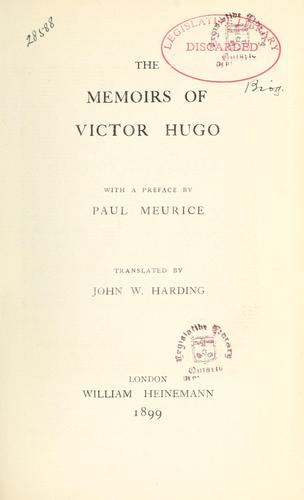
Authors, French -- 19th century -- Biography; Autobiographies; Hugo, Victor, 1802-1885
While the question of the presidency was being raised Louis Bonaparte
absented himself from the Assembly. When the Antony Thouret amendment,
excluding members of the royal and imperial families was being debated,
however, he reappeared. He seated himself at the extremity of his bench,
beside his former tutor, M. Vieillard, and listened in silence, leaning
his chin upon his hand, or twisting his moustache.
All at once he rose and, amid extraordinary agitation, walked slowly
towards the tribune. One half of the Assembly shouted: “The vote!” The
other half shouted: “Speak!”
M. Sarrans was in the tribune. The president said:
“M. Sarrans will allow M. Louis Napoleon Bonaparte to speak.”
He made a few insignificant remarks and descended from the tribune amid
a general laugh of stupefaction.
November 1848.
On November 19 I dined at Odilon Barrot’s at Bougival.
There were present MM. de Rémusat, de Tocqueville, Girardin, Leon
Faucher, a member of the English Parliament and his wife, who is ugly
but witty and has beautiful teeth, Mme. Odilon Barrot and her mother.
Towards the middle of the dinner Louis Bonaparte arrived with his
cousin, the son of Jerome, and M. Abbatucci, Representative.
Louis Bonaparte is distinguished, cold, gentle, intelligent, with
a certain measure of deference and dignity, a German air and black
moustache; he bears no resemblance whatever to the Emperor.
He ate little, spoke little, and laughed little, although the party was
a merry one.
Mme. Odilon Barrot seated him on her left. The Englishman was on her
right.
M. de Rémusat, who was seated between the prince and myself, remarked to
me loud enough for Louis Bonaparte to hear:
“I give my best wishes to Louis Bonaparte and my vote to Cavaignac.”
Louis Bonaparte at the time was feeding Mme. Odilon Barrot’s greyhound
with fried gudgeons.
II. HIS ELEVATION TO THE PRESIDENCY. December 1848.
The proclamation of Louis Bonaparte as President of the Republic was
made on December 20.
The weather, which up to then had been admirable, and reminded one more
of the approach of spring than of the beginning of winter, suddenly
changed. December 20 was the first cold day of the year. Popular
superstition had it that the sun of Austerlitz was becoming clouded.
This proclamation was made in a somewhat unexpected manner. It had been
announced for Friday. It was made suddenly on Wednesday.
Towards 3 o’clock the approaches to the Assembly were occupied by
troops. A regiment of infantry was massed in rear of the Palais d’Orsay;
a regiment of dragoons was echeloned along the quay. The troopers
shivered and looked moody. The population assembled in great uneasiness,
not knowing what it all meant. For some days a Bonapartist movement had
been vaguely spoken of. The faubourgs, it was said, were to turn out and
march to the Assembly shouting: “Long live the Emperor!” The day before
the Funds had dropped 3 francs. Napoleon Bonaparte, greatly alarmed,
came to see me.
Public-domain text, read in full here on John Shaqi.
Reviews
Reviews
No reviews yet
Be the first to share your thoughts on this work.
Elsewhere in the archive
Join the Discussion
Join the discussion
Sign in to leave a comment or review.
Sign InorCreate an account