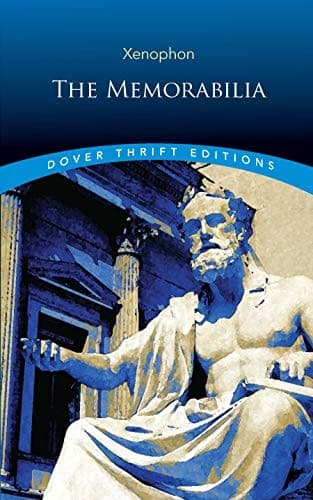
Classical literature; Philosophers, Ancient -- Biography -- Early works to 1800; Socrates -- Trials, litigation, etc. -- Early works to 1800
His own--that is, the Socratic--method of conducting a rational
discussion (42) was to proceed step by step from one point of general
agreement to another: "Herein lay the real security of reasoning," (43)
he would say; and for this reason he was more successful in winning the
common assent of his hearers than any one I ever knew. He had a saying
that Homer had conferred on Odyesseus the title of a safe, unerring
orator, (44) because he had the gift to lead the discussion from one
commonly accepted opinion to another.
(42) Of, "of threading the mazes of an argument."
(43) Reading {tauton asphaleian}; aliter. {tauten ten asphaleian} =
"that this security was part and parcel of reasoning."
(44) "Od." viii. 171, {o d' asphaleos agoreuei}, "and his speech runs
surely on its way" (Butcher and Lang), where Odysseus is
describing himself. Cf. Dion. Hal. "de Arte Rhet." xi. 8.
VII
The frankness and simplicity with which Socrates endeavoured to declare
his own opinions, in dealing with those who conversed with him, (1) is,
I think, conclusively proved by the above instances; at the same time,
as I hope now to show, he was no less eager to cultivate a spirit of
independence in others, which would enable them to stand alone in all
transactions suited to their powers.
(1) Or, "who frequented his society, is, I hope, clear from what has
been said."
Of all the men I have ever known, he was most anxious to ascertain in
what any of those about him was really versed; and within the range of
his own knowledge he showed the greatest zeal in teaching everything
which it befits the true gentleman (2) to know; or where he was
deficient in knowledge himself, (3) he would introduce his friends to
those who knew. (4) He did not fail to teach them also up to what point
it was proper for an educated man to acquire empiric knowledge of any
particular matter. (5)
(2) Lit. "a beautiful and good man."
(3) Or, "where he lacked acquaintance with the matter himself." See,
for an instance, "Econ." iii. 14.
(4) "To those who had the special knowledge"; "a connoisseur in the
matter."
(5) Or, "of any particular branch of learning"; "in each department of
things."
Public-domain text, read in full here on John Shaqi.
Reviews
Reviews
No reviews yet
Be the first to share your thoughts on this work.
Elsewhere in the archive
Join the Discussion
Join the discussion
Sign in to leave a comment or review.
Sign InorCreate an account