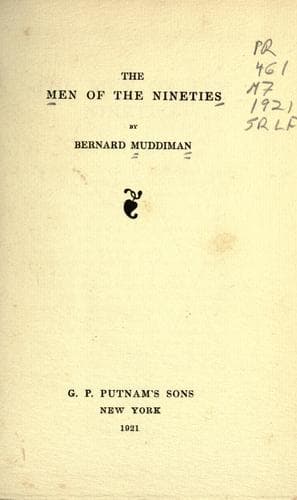
Art -- England; English literature -- 19th century -- History and criticism
Indeed, the elements that destroy the worthless, that winnow the chaff
from the grain, have been at work. For us, indeed, this landscape has
changed from what it once was, and looking at it now we acquire a new
impression which was denied to the critics of the age itself. Some of
us, without a doubt, have gone to the opposite extreme and prattle
about it as an age of platitudes, and accuse a work of art of being as
old as _The Yellow Book_. One might as well accuse a violet of being as
old as the Greek Anthology. For always, to those wandering back in the
right spirit to those days, there will come something of the infinite
zest which stirred the being of the men of the nineties to create art.
It was such an honest effort that one has to think of those times when
Marlowe and his colleagues were athrob with æsthetic aspiration to find
a similitude. The nineties, indeed, are a pleasant flower-garden in
our literature over which many strange perfumes float. There are times
when one wishes to retreat into such places, as there are moments when
the backwaters enchant us from the main stream.
It has been said it was an age of nerves. If by this is implied a
keener sensitiveness to certain feelings pulsating in the art of this
movement, one will not have very far to go to find its cause in the
French impressionistic school of Manet, which, after saturating all
types of French artists, undoubtedly invaded writers over here even
before the movement of the nineties began. On the age without a doubt
it had a lasting influence, so that to a certain degree, without being
over-busy with what went before, we may say its writers brought it
to no small degree into common use in our literature. But just as
impressionism in painting had existed centuries before in the ever-busy
mind of men like Leonardo da Vinci, one cannot go so far as to say it
had never existed before in our literature. Such a statement would be
perhaps frivolous. But it was with these men it first came to exist
as a kind of cry of a new clan. It was these men who were essentially
hectics who essayed to etch the exotic impression. The majority of
the work of the movement, in fact, can be described as impressionisms
of the abnormal by a group of individualists. For in all their work
the predominant keynote will be found to be a keen sense of that
strangeness of proportion which Bacon noted as a characteristic of what
he called beauty. It is observable as much in the poems of Dowson as in
the drawings of Beardsley, two of the leading types of the movement. It
vibrates intensely in the minor work of men like Wratislaw, and also
in John Gray’s early volume, as I have endeavoured to show. All Mr.
Arthur Symons’s criticism is a narration of his soul’s adventures in
quest of it. It stirred the genius of Charles Conder, and vitalizes the
rather cruel analysis of Hubert Crackanthorpe. We see it almost as the
animating spirit of the age itself in Oscar Wilde’s poems, _The Sphinx_
Public-domain text, read in full here on John Shaqi.
Reviews
Reviews
No reviews yet
Be the first to share your thoughts on this work.
Join the Discussion
Join the discussion
Sign in to leave a comment or review.
Sign InorCreate an account