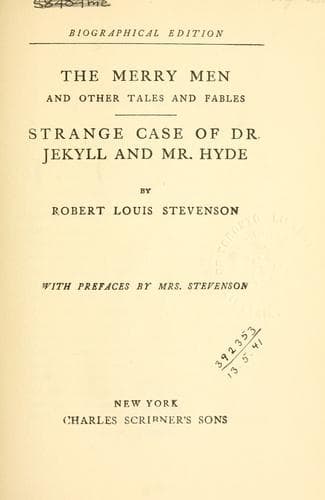
The Merry Men, and Other Tales and FablesStevenson, Robert Louis
History
The Merry Men, and Other Tales and Fables
Stevenson, Robert Louis
Boys -- Fiction; Great Britain -- History -- 19th century -- Fiction; Paranormal fiction; Treasure troves -- Fiction
All morning I went from one door to another, and entered spacious and
faded chambers, some rudely shuttered, some receiving their full charge
of daylight, all empty and unhomely. It was a rich house, on which Time
had breathed his tarnish and dust had scattered disillusion. The spider
swung there; the bloated tarantula scampered on the cornices; ants had
their crowded highways on the floor of halls of audience; the big and
foul fly, that lives on carrion and is often the messenger of death,
had set up his nest in the rotten woodwork, and buzzed heavily about
the rooms. Here and there a stool or two, a couch, a bed, or a great
carved chair remained behind, like islets on the bare floors, to
testify of man’s bygone habitation; and everywhere the walls were set
with the portraits of the dead. I could judge, by these decaying
effigies, in the house of what a great and what a handsome race I was
then wandering. Many of the men wore orders on their breasts and had
the port of noble offices; the women were all richly attired; the
canvases most of them by famous hands. But it was not so much these
evidences of greatness that took hold upon my mind, even contrasted, as
they were, with the present depopulation and decay of that great house.
It was rather the parable of family life that I read in this succession
of fair faces and shapely bodies. Never before had I so realised the
miracle of the continued race, the creation and recreation, the weaving
and changing and handing down of fleshly elements. That a child should
be born of its mother, that it should grow and clothe itself (we know
not how) with humanity, and put on inherited looks, and turn its head
with the manner of one ascendant, and offer its hand with the gesture
of another, are wonders dulled for us by repetition. But in the
singular unity of look, in the common features and common bearing, of
all these painted generations on the walls of the residencia, the
miracle started out and looked me in the face. And an ancient mirror
falling opportunely in my way, I stood and read my own features a long
while, tracing out on either hand the filaments of descent and the
bonds that knit me with my family.
Public-domain text, read in full here on John Shaqi.
Reviews
Reviews
No reviews yet
Be the first to share your thoughts on this work.
Elsewhere in the archive
Join the Discussion
Join the discussion
Sign in to leave a comment or review.
Sign InorCreate an account