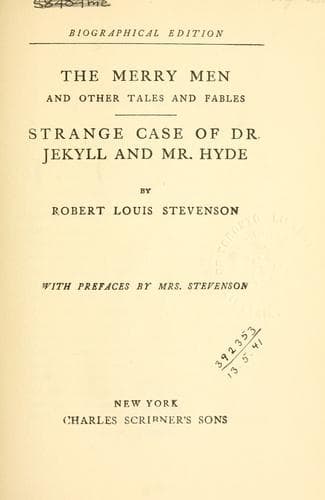
The Merry Men, and Other Tales and FablesStevenson, Robert Louis
History
The Merry Men, and Other Tales and Fables
Stevenson, Robert Louis
Boys -- Fiction; Great Britain -- History -- 19th century -- Fiction; Paranormal fiction; Treasure troves -- Fiction
It was a large place, lighted only by a single candle set upon the
floor. The mountebank lay on his back upon a pallet; a large man, with
a Quixotic nose inflamed with drinking. Madame Tentaillon stooped over
him, applying a hot water and mustard embrocation to his feet; and on a
chair close by sat a little fellow of eleven or twelve, with his feet
dangling. These three were the only occupants, except the shadows. But
the shadows were a company in themselves; the extent of the room
exaggerated them to a gigantic size, and from the low position of the
candle the light struck upwards and produced deformed foreshortenings.
The mountebank’s profile was enlarged upon the wall in caricature, and
it was strange to see his nose shorten and lengthen as the flame was
blown about by draughts. As for Madame Tentaillon, her shadow was no
more than a gross hump of shoulders, with now and again a hemisphere of
head. The chair legs were spindled out as long as stilts, and the boy
set perched atop of them, like a cloud, in the corner of the roof.
It was the boy who took the Doctor’s fancy. He had a great arched
skull, the forehead and the hands of a musician, and a pair of haunting
eyes. It was not merely that these eyes were large, or steady, or the
softest ruddy brown. There was a look in them, besides, which thrilled
the Doctor, and made him half uneasy. He was sure he had seen such a
look before, and yet he could not remember how or where. It was as if
this boy, who was quite a stranger to him, had the eyes of an old
friend or an old enemy. And the boy would give him no peace; he seemed
profoundly indifferent to what was going on, or rather abstracted from
it in a superior contemplation, beating gently with his feet against
the bars of the chair, and holding his hands folded on his lap. But,
for all that, his eyes kept following the Doctor about the room with a
thoughtful fixity of gaze. Desprez could not tell whether he was
fascinating the boy, or the boy was fascinating him. He busied himself
over the sick man: he put questions, he felt the pulse, he jested, he
grew a little hot and swore: and still, whenever he looked round, there
were the brown eyes waiting for his with the same inquiring, melancholy
gaze.
At last the Doctor hit on the solution at a leap. He remembered the
look now. The little fellow, although he was as straight as a dart, had
the eyes that go usually with a crooked back; he was not at all
deformed, and yet a deformed person seemed to be looking at you from
below his brows. The Doctor drew a long breath, he was so much relieved
to find a theory (for he loved theories) and to explain away his
interest.
For all that, he despatched the invalid with unusual haste, and, still
kneeling with one knee on the floor, turned a little round and looked
the boy over at his leisure. The boy was not in the least put out, but
looked placidly back at the Doctor.
“Is this your father?” asked Desprez.
“Oh, no,” returned the boy; “my master.”
Public-domain text, read in full here on John Shaqi.
Reviews
Reviews
No reviews yet
Be the first to share your thoughts on this work.
Elsewhere in the archive
Join the Discussion
Join the discussion
Sign in to leave a comment or review.
Sign InorCreate an account