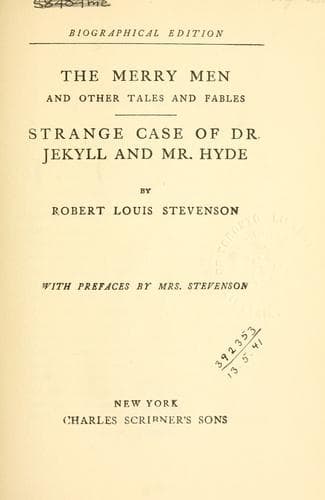
The Merry Men, and Other Tales and FablesStevenson, Robert Louis
History
The Merry Men, and Other Tales and Fables
Stevenson, Robert Louis
Boys -- Fiction; Great Britain -- History -- 19th century -- Fiction; Paranormal fiction; Treasure troves -- Fiction
The Doctor threw away his stick, bounded on the boy, clasped him to his
bosom, and kissed him on both cheeks. “Admirable, admirable imp!” he
cried. “What a morning, what an hour for a theorist of forty-two! No,”
he continued, apostrophising heaven, “I did not know such boys existed;
I was ignorant they made them so; I had doubted of my race; and now! It
is like,” he added, picking up his stick, “like a lovers’ meeting. I
have bruised my favourite staff in that moment of enthusiasm. The
injury, however, is not grave.” He caught the boy looking at him in
obvious wonder, embarrassment, and alarm. “Hullo!” said he, “why do you
look at me like that? Egad, I believe the boy despises me. Do you
despise me, boy?”
“O, no,” replied Jean-Marie, seriously; “only I do not understand.”
“You must excuse me, sir,” returned the Doctor, with gravity; “I am
still so young. O, hang him!” he added to himself. And he took his seat
again and observed the boy sardonically. “He has spoiled the quiet of
my morning,” thought he. “I shall be nervous all day, and have a
febricule when I digest. Let me compose myself.” And so he dismissed
his pre-occupations by an effort of the will which he had long
practised, and let his soul roam abroad in the contemplation of the
morning. He inhaled the air, tasting it critically as a connoisseur
tastes a vintage, and prolonging the expiration with hygienic gusto. He
counted the little flecks of cloud along the sky. He followed the
movements of the birds round the church tower—making long sweeps,
hanging poised, or turning airy somersaults in fancy, and beating the
wind with imaginary pinions. And in this way he regained peace of mind
and animal composure, conscious of his limbs, conscious of the sight of
his eyes, conscious that the air had a cool taste, like a fruit, at the
top of his throat; and at last, in complete abstraction, he began to
sing. The Doctor had but one air—, “Malbrouck s’en va-t-en guerre;”
even with that he was on terms of mere politeness; and his musical
exploits were always reserved for moments when he was alone and
entirely happy.
He was recalled to earth rudely by a pained expression on the boy’s
face. “What do you think of my singing?” he inquired, stopping in the
middle of a note; and then, after he had waited some little while and
received no answer, “What do you think of my singing?” he repeated,
imperiously.
“I do not like it,” faltered Jean-Marie.
“Oh, come!” cried the Doctor. “Possibly you are a performer yourself?”
“I sing better than that,” replied the boy.
The Doctor eyed him for some seconds in stupefaction. He was aware that
he was angry, and blushed for himself in consequence, which made him
angrier. “If this is how you address your master!” he said at last,
with a shrug and a flourish of his arms.
“I do not speak to him at all,” returned the boy. “I do not like him.”
“Then you like me?” snapped Doctor Desprez, with unusual eagerness.
“I do not know,” answered Jean-Marie.
Public-domain text, read in full here on John Shaqi.
Reviews
Reviews
No reviews yet
Be the first to share your thoughts on this work.
Elsewhere in the archive
Join the Discussion
Join the discussion
Sign in to leave a comment or review.
Sign InorCreate an account