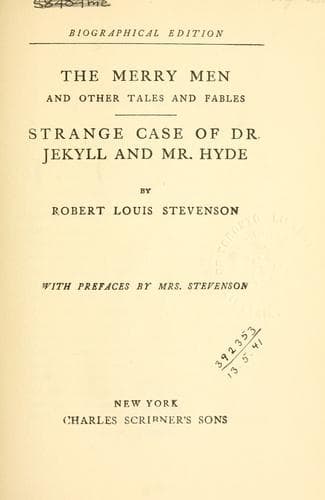
The Merry Men, and Other Tales and FablesStevenson, Robert Louis
History
The Merry Men, and Other Tales and Fables
Stevenson, Robert Louis
Boys -- Fiction; Great Britain -- History -- 19th century -- Fiction; Paranormal fiction; Treasure troves -- Fiction
“You must not be surprised nor frightened by my husband’s manners,” she
said. “He is the kindest of men, but so clever that he is sometimes
difficult to understand. You will soon grow used to him, and then you
will love him, for that nobody can help. As for me, you may be sure, I
shall try to make you happy, and will not bother you at all. I think we
should be excellent friends, you and I. I am not clever, but I am very
good-natured. Will you give me a kiss?”
He held up his face, and she took him in her arms and then began to
cry. The woman had spoken in complaisance; but she had warmed to her
own words, and tenderness followed. The Doctor, entering, found them
enlaced: he concluded that his wife was in fault; and he was just
beginning, in an awful voice, “Anastasie—,” when she looked up at him,
smiling, with an upraised finger; and he held his peace, wondering,
while she led the boy to his attic.
CHAPTER IV.
THE EDUCATION OF A PHILOSOPHER.
The installation of the adopted stable-boy was thus happily effected,
and the wheels of life continued to run smoothly in the Doctor’s house.
Jean-Marie did his horse and carriage duty in the morning; sometimes
helped in the housework; sometimes walked abroad with the Doctor, to
drink wisdom from the fountain-head; and was introduced at night to the
sciences and the dead tongues. He retained his singular placidity of
mind and manner; he was rarely in fault; but he made only a very
partial progress in his studies, and remained much of a stranger in the
family.
The Doctor was a pattern of regularity. All forenoon he worked on his
great book, the “Comparative Pharmacopoeia, or Historical Dictionary of
all Medicines,” which as yet consisted principally of slips of paper
and pins. When finished, it was to fill many personable volumes, and to
combine antiquarian interest with professional utility. But the Doctor
was studious of literary graces and the picturesque; an anecdote, a
touch of manners, a moral qualification, or a sounding epithet was sure
to be preferred before a piece of science; a little more, and he would
have written the “Comparative Pharmacopoeia’ in verse! The article
“Mummia,” for instance, was already complete, though the remainder of
the work had not progressed beyond the letter A. It was exceedingly
copious and entertaining, written with quaintness and colour, exact,
erudite, a literary article; but it would hardly have afforded guidance
to a practising physician of to-day. The feminine good sense of his
wife had led her to point this out with uncompromising sincerity; for
the Dictionary was duly read aloud to her, betwixt sleep and waning, as
it proceeded towards an infinitely distant completion; and the Doctor
was a little sore on the subject of mummies, and sometimes resented an
allusion with asperity.
Public-domain text, read in full here on John Shaqi.
Reviews
Reviews
No reviews yet
Be the first to share your thoughts on this work.
Elsewhere in the archive
Join the Discussion
Join the discussion
Sign in to leave a comment or review.
Sign InorCreate an account