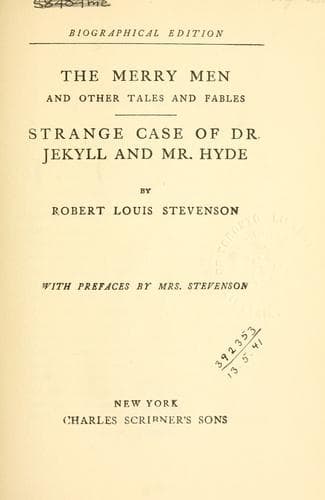
The Merry Men, and Other Tales and FablesStevenson, Robert Louis
History
The Merry Men, and Other Tales and Fables
Stevenson, Robert Louis
Boys -- Fiction; Great Britain -- History -- 19th century -- Fiction; Paranormal fiction; Treasure troves -- Fiction
One beautiful June day they sat upon the hill outside the village. The
river, as blue as heaven, shone here and there among the foliage. The
indefatigable birds turned and flickered about Gretz church tower. A
healthy wind blew from over the forest, and the sound of innumerable
thousands of tree-tops and innumerable millions on millions of green
leaves was abroad in the air, and filled the ear with something between
whispered speech and singing. It seemed as if every blade of grass must
hide a cigale; and the fields rang merrily with their music, jingling
far and near as with the sleigh-bells of the fairy queen. From their
station on the slope the eye embraced a large space of poplar’d plain
upon the one hand, the waving hill-tops of the forest on the other, and
Gretz itself in the middle, a handful of roofs. Under the bestriding
arch of the blue heavens, the place seemed dwindled to a toy. It seemed
incredible that people dwelt, and could find room to turn or air to
breathe, in such a corner of the world. The thought came home to the
boy, perhaps for the first time, and he gave it words.
“How small it looks!” he sighed.
“Ay,” replied the Doctor, “small enough now. Yet it was once a walled
city; thriving, full of furred burgesses and men in armour, humming
with affairs;—with tall spires, for aught that I know, and portly
towers along the battlements. A thousand chimneys ceased smoking at the
curfew bell. There were gibbets at the gate as thick as scarecrows. In
time of war, the assault swarmed against it with ladders, the arrows
fell like leaves, the defenders sallied hotly over the drawbridge, each
side uttered its cry as they plied their weapons. Do you know that the
walls extended as far as the Commanderie? Tradition so reports. Alas,
what a long way off is all this confusion—nothing left of it but my
quiet words spoken in your ear—and the town itself shrunk to the hamlet
underneath us! By-and-by came the English wars—you shall hear more of
the English, a stupid people, who sometimes blundered into good—and
Gretz was taken, sacked, and burned. It is the history of many towns;
but Gretz never rose again; it was never rebuilt; its ruins were a
quarry to serve the growth of rivals; and the stones of Gretz are now
erect along the streets of Nemours. It gratifies me that our old house
was the first to rise after the calamity; when the town had come to an
end, it inaugurated the hamlet.”
“I, too, am glad of that,” said Jean-Marie.
“It should be the temple of the humbler virtues,” responded the Doctor
with a savoury gusto. “Perhaps one of the reasons why I love my little
hamlet as I do, is that we have a similar history, she and I. Have I
told you that I was once rich?”
“I do not think so,” answered Jean-Marie. “I do not think I should have
forgotten. I am sorry you should have lost your fortune.”
Public-domain text, read in full here on John Shaqi.
Reviews
Reviews
No reviews yet
Be the first to share your thoughts on this work.
Elsewhere in the archive
Join the Discussion
Join the discussion
Sign in to leave a comment or review.
Sign InorCreate an account