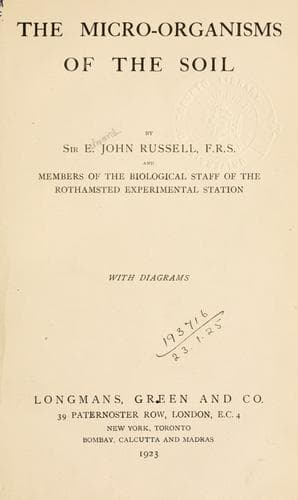
The micro-organisms of the soilRussell, Edward J. (Edward John)
Science
The micro-organisms of the soil
Russell, Edward J. (Edward John)
Soil microbiology
It must be borne in mind that these estimates only apply to average
conditions; the outbreak of a plant pest in any one year must naturally
materially alter the proportions given. The phytophagous organisms are
represented by a certain number of the _Insecta_ together with the
pulmonate _Mollusca_. Carnivorous forms which are mainly beneficial
from the agricultural standpoint, include _Insecta_, together with
the _Chilopoda_, many _Acarina_ and the _Areinida_. Saprophagous
forms constitute the dominant element of the soil fauna. More than
30 per cent. of the _Insecta_ exhibit this habit, which is also the
dominant one in the _Oligochæta_, _Symphyla_, and in many of the soil
_Nematodes_. Heterophagous species include all those of somewhat
plastic habits; for the most part they are saprophagous, but, on the
other hand, a considerable proportion of the species attack growing
plants or exhibit both habits. Under this category are included a
certain number of the _Insecta_, the _Diplopoda_, _Isopoda_, and some
_Acarina_.
THE INFLUENCE OF ENVIRONMENTAL FACTORS UPON THE INVERTEBRATES OF THE
SOIL.
Since animals are endowed with powers of independent locomotion: they
are not necessarily tied to their environment to the same extent
that plants are. The investigation of the influence of environmental
factors sooner or later involves a study of the tropisms of the
animals concerned. Until these are adequately understood it is
scarcely possible to arrive at any exact conclusions relative to their
behaviour in the soil. Insects, for example, respond to the stimuli of
various, and often apparently insignificant forces, acting upon their
sensory organs. Such responses are known as chemotropism, phototropism,
hydrotropism, thermotropism, and so forth according to the nature of
the stimuli. Tropisms are automatic and, so far as they distinguish
sensations, are independent of any choice, and consequently of psychic
phenomena. Animal automatism, however, does not present the rigidity
of mechanical automatism. Differential sensibility, vital rhythms, or
periodicity, etc., are other important aspects of animal behaviour.
Public-domain text, read in full here on John Shaqi.
Reviews
Reviews
No reviews yet
Be the first to share your thoughts on this work.
Elsewhere in the archive
Join the Discussion
Join the discussion
Sign in to leave a comment or review.
Sign InorCreate an account