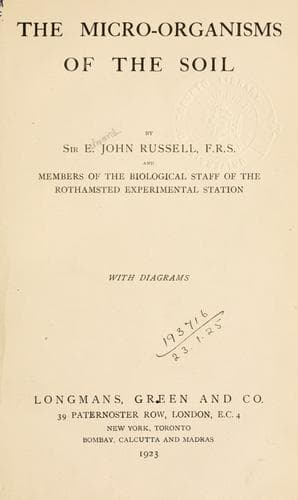
The micro-organisms of the soilRussell, Edward J. (Edward John)
Science
The micro-organisms of the soil
Russell, Edward J. (Edward John)
Soil microbiology
The importance of the organic matter present in the soil is well
illustrated in the table on p. 152. The great increase in the number of
insects and other animals is partly due to their direct introduction
along with the manure, and partly to their entry into the soil in
response to chemotropic stimuli exerted by fermentation. Organic matter
influences the fauna in other ways also; it increases the moisture
content of the soil, and it provides many species with an abundance of
food material. Also, the amount of carbon dioxide present in the soil
is partly dependent upon decaying organic matter. Hamilton conducted
experiments on the behaviour of certain soil insects in relation to
varying amounts of carbon dioxide. Although his work is of too limited
a nature to be accepted without reserve, it lends support to the
conclusions of Adams who says: “The animals which thrive in the soil
are likely to be those which tolerate a large amount of carbon dioxide,
and are able to use a relatively small amount of oxygen, at least for
considerable intervals, as when the soil is wet during prolonged rains.
The optimum soil habitat is therefore determined, to a very important
degree, by the proper ratio or balance between the amount of available
oxygen and the amount of carbon dioxide which can be endured without
injury.”
Little is known concerning the occurrence of ammonia in the soil
atmosphere, but its presence in minute quantities is probably an
important chemotropic factor in relation to saprophagous organisms
which are the largest constituent of the fauna. A great increase in
Dipterous larvæ occurs on the addition of farmyard manure, and this
is noteworthy in the light of Richardson’s experiments (1916), which
indicate that ammonia exercises a marked attraction for _Diptera_,
which spend some part of their existence in animal excrement in some
form or another.
The nature of the vegetation supported by the soil is of paramount
importance in relation to phytophagous organisms, and examples need
scarcely be instanced of certain species of soil insects being
dependent upon the presence of their specific food plants.
THE RELATION OF SOIL INVERTEBRATES TO AGRICULTURE.
The relation of these organisms to agriculture may be considered from
three points of view: (_a_) their influence upon the soil itself; (_b_)
their relation to the nitrogen cycle; and (_c_), their direct influence
upon economic plants.
Public-domain text, read in full here on John Shaqi.
Reviews
Reviews
No reviews yet
Be the first to share your thoughts on this work.
Elsewhere in the archive
Join the Discussion
Join the discussion
Sign in to leave a comment or review.
Sign InorCreate an account