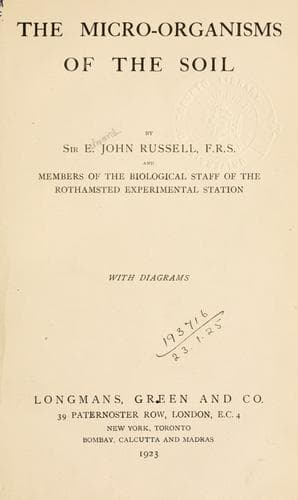
The micro-organisms of the soilRussell, Edward J. (Edward John)
Science
The micro-organisms of the soil
Russell, Edward J. (Edward John)
Soil microbiology
[51] Mockeridge, J., Biochem. Journ., 1915, vol. ix., p. 272.
[52] Nabokich, A. J., and Lebedeff, A. F., Centr. f. Bakt., 1906,
Abt. II., Bd. 17, p. 350.
[53] Nagaoka, M., Bull. Coll. Agr., Tokyo, 1900, vol. vi., No. 3.
[54] Omelianski, W. L., Comptes Rendus Acad. Sci., 1895, vol. cxxi.,
p. 653; 1897, vol. cxxv., pp. 907, 1131; Arch. Sci. Bio., (St.
Petersburg), 1899, vol. vii., p. 411.
[55] Omelianski, W. L., and Sohmskov, M., Arch. Sci. Biol., Publ.
Inst. Imp. Med. Exp. (Petrograd), 1916, vol. xviii., pp. 327, 338,
459; vol. xix., p. 162.
[56] Prescott, J. A., Journ. Agr. Sci., 1920, vol. x., p. 177.
[57] Söhngen, N. L., Centr. f. Bakt., 1905, Abt. II., Bd. 15, p. 513.
[58] Sen Gupta, N., Journ. Agr. Sci., 1921, vol. xi., p. 136.
[59] Shearer, C., Journ. Hyg., 1919, vol. xviii., p. 337.
[60] Tappeiner, Ber. Deut. Chem. Gesell., 1883, vol. xvi., p. 1734;
Zeitsch. Biol., 1884, vol. xx., p. 52.
[61] Thornton, H. G., Ann. Appl. Biol., 1922, vol. ix., p. 241.
[62] Wallin, I. E., Journ. Bact., 1922, vol. vii., p. 471.
[63] Waksman, S. A., and Joffe, J. S., Journ. Bact., 1922, vol. vii.,
p. 239.
[64] Wilson, J. K., Cornell Agric. Exp. Sta., 1917, Bulletin 386.
CHAPTER IV.
PROTOZOA OF THE SOIL, I.
That protozoa could be isolated from the soil was a matter of common
knowledge to the biologists of the nineteenth century, but not until
the early part of the present century was it suggested that these
organisms might be playing some part in the general economy of the soil
micro-population. Of recent years a great deal of our knowledge of the
cytology of the different groups of protozoa, especially the Amœbæ, has
been obtained from the study of representatives normally living in the
soil; but unfortunately little or no knowledge has been gained of the
biology of these animals in their natural habitat.
The view that the presence of these organisms in excessive numbers may
lead to “soil sickness” was first put forward by Russell and Hutchinson
in 1909, and elaborated in their further papers dealing with “Partial
Sterilisation of the Soil.”
It is unnecessary to discuss in detail this important branch of
agriculture, but to obtain a clear idea of the development of
the study of soil protozoa it is necessary to give as briefly as
possible the conclusions deduced by Russell and Hutchinson from their
extensive experiments on soils treated with steam and various volatile
antiseptics[21],[22]:--
“(1) Partial sterilisation of the soil causes first a fall, then a
rise, in bacterial numbers, which goes on till the numbers considerably
exceed those present in the original soil.
“(2) Simultaneously there is a marked increase in the rate of
accumulation of ammonia which is formed from organic nitrogen
compounds.
“(3) The increase in bacterial numbers is the result of improvement in
the soil as a medium for bacterial growth, and not an improvement in
the bacterial flora.
Public-domain text, read in full here on John Shaqi.
Reviews
Reviews
No reviews yet
Be the first to share your thoughts on this work.
Join the Discussion
Join the discussion
Sign in to leave a comment or review.
Sign InorCreate an account