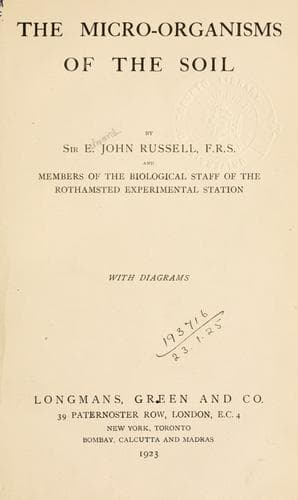
The micro-organisms of the soilRussell, Edward J. (Edward John)
Science
The micro-organisms of the soil
Russell, Edward J. (Edward John)
Soil microbiology
The experimental difficulties of dealing with soil protozoa are
considerable, and without a thoroughly sound technique investigators
may easily go astray.
CLASSIFICATION.
The animal kingdom is divided into two main groups or sub-kingdoms--the
Protozoa and the Metozoa. In the latter the characteristic feature
is that the body is composed of several units, called cells, and
consequently such animals are often spoken of as multicellular. The
Protozoa, on the other hand, are usually designated as uni-cellular,
since their bodies are regarded as being homologous to a single unit or
cell of the metozoan body. For various reasons exception has been taken
by Dobell[9] and others to the use of the term uni-cellular, for, as
Dobell says, “If we regard the whole organism as an individual unit,
then the whole protozoan is strictly comparable with a whole metozoon,
and not with a part of it. But the body of a protozoan, though it shows
great complexity of structure, is not differentiated internally into
cells, like the body of a metozoon. Consequently it differs from the
latter not in the number of its cellular constituents, but in lacking
these altogether. We therefore define the sub-kingdom of the protozoa
as the group which contains _all non-cellular animals_.”
It should be pointed out that this view does not find favour with many
zoologists, but it is useful in bringing into prominence the fact
that each protozoan is comparable as regards its functions with the
multi-cellular animals.
The protozoa are again further divided into four main classes:--
I. Rhizopoda.
II. Mastigophora.
III. Ciliophora.
IV. Sporozoa.
Of the above classes, representatives of each of the first three are
found living in the soil, but up to the present there is no evidence
that any sporozoon is capable of living an active life in the soil,
though the cysts of such organisms may be present.
The class _RHIZOPODA_ consists of those protozoa whose organs of
locomotion and food capture are _pseudopodia_, that is, temporary
extensions of the living protoplasm. The body is typically naked, that
is to say, without any cuticular membrane, though in some forms, ex.
_Amœbæ terricola_, the external layer of protoplasm is thickened to
form a pellicle. A skeleton or shell may be present.
The class is further sub-divided into various sub-classes, only
two of which concern the soil protozoologist, viz., the _Amœbæ_
and the _Mycetozoa_, of which the most important representative is
_Plasmodiophora brassicæ_, which attacks the roots of many cruciferous
plants, causing the disease familiarly known as “Fingers and Toes.”
The _Amœbæ_ are again divided into two orders:--
(_a_) _Nuda_, without shell or skeleton;
(_b_) _Testacea_, with shells often termed _Thecamœbæ_.
Public-domain text, read in full here on John Shaqi.
Reviews
Reviews
No reviews yet
Be the first to share your thoughts on this work.
Join the Discussion
Join the discussion
Sign in to leave a comment or review.
Sign InorCreate an account