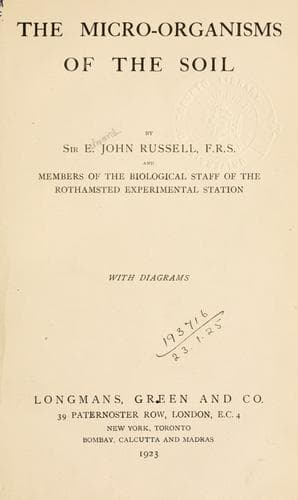
The micro-organisms of the soilRussell, Edward J. (Edward John)
Science
The micro-organisms of the soil
Russell, Edward J. (Edward John)
Soil microbiology
“It is difficult to see what agent other than a living organism can
fulfil these conditions. Search was therefore made for a larger
organism capable of destroying bacteria, and considerable numbers of
protozoa were found. The ciliates and amœbæ are killed by partial
sterilisation. Whenever they are killed the detrimental factor is found
to be put out of action; the bacterial numbers rise and maintain a high
level. Whenever the detrimental factor is not put out of action, the
protozoa are not killed. To these rules we have found no exception.”
From such premises as the above Russell and Hutchinson founded the
“protozoa theory of partial sterilisation,” and at Rothamsted there was
commenced the serious study of these soil organisms.
Goodey was one of the early workers on this new subject, and added
considerably to our knowledge of the species living in normal soils,
and of the chemical constitution of the cyst wall of ciliates. He
also made investigations on the effects of various chemicals on the
micro-population of soils, but was unable to draw very definite
conclusions.[11]
One of the first criticisms raised against the protozoa theory of
partial sterilisation was that the protozoa were not normal inhabitants
of the soil, and were present only in small numbers, all of them in the
cystic, quiescent condition. It was further held that these cysts were
carried by the wind from dried-up ponds and streams. It is difficult to
trace the origin of this view, since early observers, viz., Ehrenberg
and Dujardin, in 1841, were of the opinion that the protozoa were
living in the trophic active condition in the soil, and it was not
until 1878 that Stein showed that free living protozoa can encyst. To
Martin and Lewin, however, must be ascribed the distinction of first
proving that the soil possesses an active protozoan population, for
by a series of ingenious experiments these observers isolated several
flagellates and amœbæ in a trophic condition from certain of the
Rothamsted soils.[18] The more recent work in this country has been
in the direction of devising new quantitative methods of research,
since by this means alone is it possible to elucidate many fundamental
questions.
In America and elsewhere experiments have been devised for testing the
conclusions of Russell and Hutchinson. Cunningham and Löhnis,[2] in
America, Truffaut and Bezssonoff,[24] in France, supply evidence in
favour of the theory, but most of the American work is in opposition to
it.
Sherman[23] is perhaps the most prominent in opposing the phagocytic
action of protozoa on soil bacteria in spite of the fact that certain
of his experimental results apparently show enormous decreases in
bacterial numbers in the presence of protozoa. In many of his soil
inoculation experiments, however, it was not demonstrated that his
active cultures remained alive after entering the soil.
Public-domain text, read in full here on John Shaqi.
Reviews
Reviews
No reviews yet
Be the first to share your thoughts on this work.
Join the Discussion
Join the discussion
Sign in to leave a comment or review.
Sign InorCreate an account