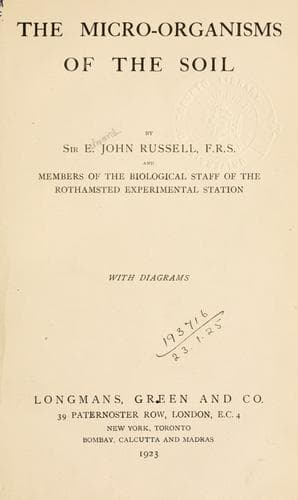
The micro-organisms of the soilRussell, Edward J. (Edward John)
Science
The micro-organisms of the soil
Russell, Edward J. (Edward John)
Soil microbiology
IV. _Peritricha._ Typically of a sedentary habit and the cilia are
reduced to a zone round the adoral region of the body. A typical soil
form is _Vorticella microstomum_.
The above classification is far from complete, but should be sufficient
to give an idea of the general grouping of the organisms. For a more
detailed account reference must be made to the numerous text books on
protozoa.
LIFE HISTORIES.
The life history of each species has its own characteristic features as
regards nuclear division, etc., and in many forms, notably the amœbæ,
it is impossible to identify them with certainty unless the chief
stages of the life history are known. In general, however, the soil
protozoa pass through very similar phases and develop in a perfectly
straightforward way. Broadly speaking, there are two main phases of
the life history--a period of activity often mistermed vegetative, and
a period of rest. In the former the animal moves, feeds and reproduces,
while in the latter there is secreted round the body a thick wall,
capable of resisting adverse external influences. This condition is
termed the cystic stage, and by means of it the animals are distributed
from place to place by air, water, etc. Indeed, so resistant are the
cysts that many of them are capable of withstanding the action of the
digestive juices of the intestines of animals, through which they pass
to be deposited by the fæces on fresh ground.
This cystic stage of the life history is found in practically all
free-living protozoa, though it is not formed in exactly the same
manner in every case. In the majority of instances the cyst is the
product of a single organism, round which is formed a delicate
gelatinous substance which soon hardens and gradually acquires the
peculiar characters of the wall. Concerning the chemical nature of this
wall there is little known, but Goodey,[11] working on the cysts of
_Colpoda cucullus_, found it to be formed of a carbohydrate, different
from all carbohydrates previously described, to which the name “Cytose”
was given. When in this state the animals are able to remain dormant
for considerable periods until favourable conditions once more obtain
when the wall is ruptured and the animal again resumes the active phase
of its life history. This simple process is characteristic of such
species as _Heteromita globosus_, _Cercomonas spp._, and many others.
It will be noted that no increase of numbers, i.e. reproduction,
occurs. A more complex condition is, however, sometimes found, as, for
example, in the ciliate _Colpoda steinii_, where actual reproduction
into small animals takes place within the cyst.
Public-domain text, read in full here on John Shaqi.
Reviews
Reviews
No reviews yet
Be the first to share your thoughts on this work.
Elsewhere in the archive
Join the Discussion
Join the discussion
Sign in to leave a comment or review.
Sign InorCreate an account