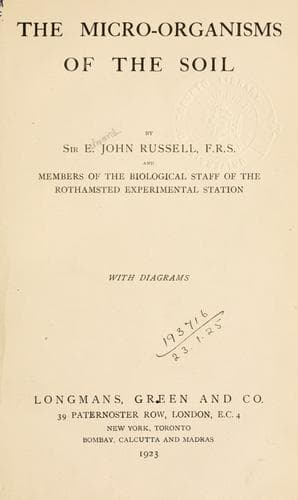
The micro-organisms of the soilRussell, Edward J. (Edward John)
Science
The micro-organisms of the soil
Russell, Edward J. (Edward John)
Soil microbiology
Finally there is the less common type of cyst formation, such as is
found in the flagellate _Oicomonas termo_ described by Martin.[19] This
flagellate, in common with all other forms, reproduces by dividing into
two; the division of the nucleus initiating the process. At certain
undetermined periods of the life history, however, conjugation occurs
between two similar animals forming a large biflagellate body known as
the zygote. After swimming about for varying periods of time, during
which the size increases and a large vacuole appears, the zygote
secretes a thick wall, loses its flagella, and becomes a cyst. While in
this condition the two gamete nuclei fuse to form one, and eventually a
single _Oicomonas_ emerges from its cyst.
Similarly in _A. diploidea_ the cysts are formed after two individuals
have come together. In the young cysts two amœbæ are found in close
association, and according to Hartmann and Nägler[12] a sexual process
occurs inside the cyst involving a “reductive” division of the nuclei.
This requires confirmation, but it is certain that only one individual
comes out of the cysts, which originally contained two amœbæ.
Such cysts have been termed by some writers “reproductive,” evidently a
misleading term, since no increase in numbers, but rather a decrease,
results from the process. A better term is, perhaps, conjugation cyst.
In soil protozoa, then, three different modes of cyst formation obtain,
and failure to make the distinction inevitably leads to confusion.
Before leaving the question of life histories, reference must be made
to a peculiar and characteristic feature of _Nægleria gruberi_. This
amœba under certain circumstances assumes a free-swimming biflagellate
stage. After variable periods of time the flagella are lost and the
ordinary amœboid condition resumed. What are the factors concerned in
the production of flagellates is unknown, but flooding the coverslips
with distilled water is an effective method for causing their
appearance.
DISTRIBUTION OF SOIL PROTOZOA.
For both the bacteria and algæ observations have been made regarding
their distribution through successive depths of the soil; little can
be said, however, about the protozoa in this connection. It is certain
that they occur throughout the first six inches of the Rothamsted
soils, though their relative frequencies in the successive inches has
not been determined, but probably they are most abundant in the 2nd to
the 4th inch.
In this country experiments have not been made to determine whether
sub-soil normally contains protozoa; but from some South African
soil, taken under sterile conditions 4 ft. down and examined in this
laboratory, large numbers of protozoa were cultivated.
This soil, however, could not, for various reasons, be regarded as a
typical sub-soil.
Public-domain text, read in full here on John Shaqi.
Reviews
Reviews
No reviews yet
Be the first to share your thoughts on this work.
Elsewhere in the archive
Join the Discussion
Join the discussion
Sign in to leave a comment or review.
Sign InorCreate an account