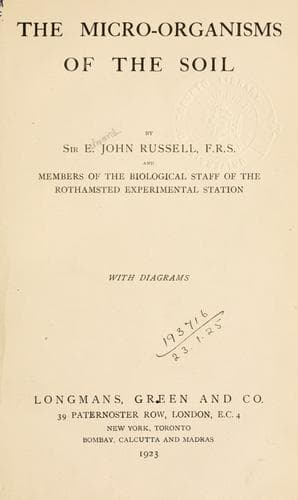
The micro-organisms of the soilRussell, Edward J. (Edward John)
Science
The micro-organisms of the soil
Russell, Edward J. (Edward John)
Soil microbiology
Kofoid records the presence of _Nægleria gruberi_ in clay and rock
talus taken from the sides of excavations of over 20 ft. depth, but the
possibility of external infection does not appear to have been excluded.
The presence of protozoa is not peculiar to British soil since they
have been found by various workers in Germany, France, the United
States, and elsewhere. In view of their probable importance in the soil
economy there has been instituted a survey of the protozoan species of
soil from all parts of the world.
This work is in charge of Mr. Sandon, to whom I am indebted for the
following summary of his as yet unpublished research.
“The majority of soil protozoa (like the fresh-water forms) appear to
be quite cosmopolitan, for the species found in such widely separated
localities as England, Spitsbergen, Africa, West Indies, Gough Island
(in the South Atlantic) and Nauru (in the Pacific) are, with few
exceptions, identical. This distribution indicates an ability to
withstand an extremely wide range of conditions, for the same species
occurring in Arctic soils, which are frozen for the greater part of
the year, are found also in soils exposed to the direct rays of the
tropical sun. Even sand from the Egyptian desert contains protozoa,
though it seems probable that in such cases they must be present only
in the encysted condition for the greater part of the time.
“Not every sample of soil, however, contains all the species capable
of living in soil, but the local conditions determining the presence
or absence of any species are at present unknown. In general the
numbers, both of species and of individuals present, follow the number
of bacteria. They are consequently most numerous in rich moist soils.
The statement sometimes made that protozoa are most numerous in peaty
soils is based solely on the number of Rhizopod shells found in such
localities; but as most of these shells are empty, their abundance is
probably due simply to the slowness with which they disintegrate in
these soils where bacterial activity is low, they do not indicate a
great protozoal activity. Active protozoa do occur even in extremely
acid soils, but their numbers in such cases are low. The common soil
protozoa, in fact, appear to be as tolerant of differences in soil
acidity as they are of differences in climate, for many of the same
forms which occur in acid soils are found also in soils containing
high percentages of chalk. It is possible that some of the less common
species may be confined within closer limits of external conditions but
the information available on this point is inadequate. All the species,
however, which in Rothamsted soils occur in the highest numbers (e.g.
_Oicomonas termo_, _Heteromita spp._, _Cercomonas crassicauda_,
_Nægleria gruberi_, _Colpoda cucullus_, _C. steinii_) occur in
practically every soil which is capable of supporting vegetation,
though, of course, in very varying numbers.”
Public-domain text, read in full here on John Shaqi.
Reviews
Reviews
No reviews yet
Be the first to share your thoughts on this work.
Elsewhere in the archive
Join the Discussion
Join the discussion
Sign in to leave a comment or review.
Sign InorCreate an account