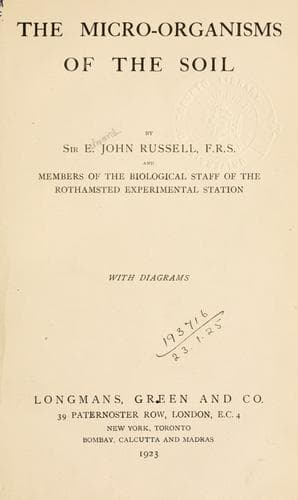
The micro-organisms of the soilRussell, Edward J. (Edward John)
Science
The micro-organisms of the soil
Russell, Edward J. (Edward John)
Soil microbiology
If, as seems to be indubitable, the micro-organisms of the soil are of
importance to soil fertility, it is necessary for us to know in what
way this population is affected by the application of fertilisers,
and a start has been made by investigating the effects of hydrogen
ion concentration on soil protozoa. Much has already been written
concerning this question, but almost entirely on results obtained
in artificial cultures. It is always dangerous to argue from the
artificial to the natural environment of organisms and particularly
so in respect to the soil. Also, as Collett has shown, the toxic
effects of acids are probably not entirely a function of the hydrogen
ion concentration, but that the molecules of certain acids are in
themselves toxic, an action which can, however, be diminished by the
antagonistic powers of many substances such as NaCl.
In this laboratory S. M. Nasir, by unpublished work, has shown that
the limiting value on the acid side for _Colpoda cucullus_ was P_{H}
3·3; for a flagellate (_Heteromita globosus_), 3·5; and for an amœba
(_Nægleria gruberi_), 3·9.
Also Mlle. Perey, investigating the numbers of protozoa in one of the
Rothamsted grass plots of P_{H} 3·65, found a total of 13,600 protozoa,
of which 90 per cent. were active.
The tolerance, therefore, of these organisms to varying external
conditions is greater than has formerly been supposed, a conclusion
which is becoming more evident from the researches mentioned in Chapter
IV. on soils from different parts of the world.
PROTOZOA AND THE NITROGEN CYCLE.
In partially-sterilised soil from which protozoa were absent Russell
and Hutchinson obtained an increased ammonia production, a result
also obtained by Cunningham. Hill, on the other hand, concluded that
protozoa have no effect on ammonification, but his technique is open to
criticism.
Lipman, Blair, Owen and McLean’s work[17] contains many figures
obtained by adding dried blood, tankage, soluble blood flour,
cottonseed meal, soy-bean meal, wheat flour, corn meal, etc., to soil.
It is difficult to understand how accurate results could be expected
when, to an already little understood complex substance, such as soil,
is added a series of substances whose effects are practically unknown.
Free nitrogen-fixation in soils is an important process, more
especially in soils of a light sandy nature, from which crops are
taken year after year without any application of manure. The effect of
protozoa on the organisms causing this process has in the past received
little attention. Recently, however, Nasir[20] has studied the
influence of protozoa on Azotobacter, both in artificial culture and in
sand. From a total of 36 experiments done in duplicate or triplicate,
31 showed a decided gain in nitrogen fixation over the control, while
only 5 gave negative results.
Public-domain text, read in full here on John Shaqi.
Reviews
Reviews
No reviews yet
Be the first to share your thoughts on this work.
Elsewhere in the archive
Join the Discussion
Join the discussion
Sign in to leave a comment or review.
Sign InorCreate an account