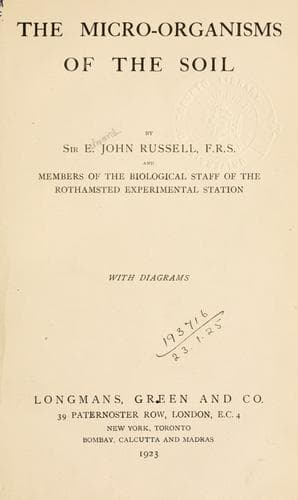
The micro-organisms of the soilRussell, Edward J. (Edward John)
Science
The micro-organisms of the soil
Russell, Edward J. (Edward John)
Soil microbiology
Speaking broadly, the organisms of the soil may be classified into
several distinct groups differing conspicuously in their general
characters and physiological functions and therefore in their economic
significance; among such groups may be mentioned the bacteria,
protozoa, algæ and fungi. It is found, however, that though typical
members of these groups are conspicuously different from one another,
yet there exist a number of unicellular forms which have characters
in common with more than one of these big groups, and the lines of
demarcation between them become difficult to define. It becomes
advisable, therefore, to depart a little from the systematist’s rigid
definitions and to adopt a somewhat more logical grouping of the soil
organisms based on their mode of life.
To give but a single example: _Euglena viridis_ occurs quite commonly
in soil. Through its single flagellum, its lack of a definite cellulose
wall, its changeable shape and its ability to multiply by simple
fission in the motile state it definitely belongs systematically to the
group of protozoa. But its possession of chlorophyll, in enabling it to
synthesise complex organic substances from CO₂ and water in a manner
entirely typical of plants, connects it physiologically so closely with
the lower green algæ that in studying the biology of the soil it seems
best to include it and other nearly related forms with the algæ.
On this physiological basis “soil-algæ” may be defined as those
micro-organisms of the soil which have the power, under suitable
conditions, to produce chlorophyll. Such a definition has the
advantage that it is wide enough to include the filamentous protonema
of mosses, which, though alga-like in form and in physiological
action, is nevertheless separated from the true algæ by a wide gulf.
A more accurate name for such a group of organisms would be the
“chlorophyll-bearing protophyta” of the soil; they may be classified
briefly as follows (Table IX.):--
TABLE IX.
Public-domain text, read in full here on John Shaqi.
Reviews
Reviews
No reviews yet
Be the first to share your thoughts on this work.
Elsewhere in the archive
Join the Discussion
Join the discussion
Sign in to leave a comment or review.
Sign InorCreate an account