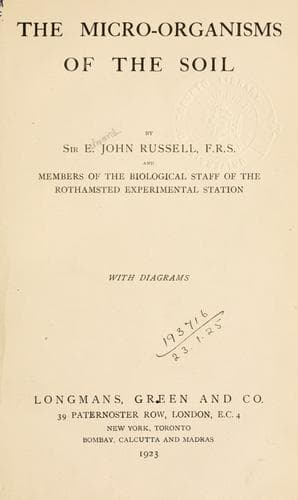
The micro-organisms of the soilRussell, Edward J. (Edward John)
Science
The micro-organisms of the soil
Russell, Edward J. (Edward John)
Soil microbiology
In considering the alga-flora of a soil it is necessary to distinguish
between two very different sets of conditions under which the organisms
may be growing. In the first place, they may grow on the surface of the
soil, being subjected directly to insolation, rain, the deposition of
dew, the drying action of wind, relatively quick changes of temperature
and other effects of climate. Certain combinations of these conditions
present so favourable an environment for the growth of algæ that at
times there appears on the surface of the soil a conspicuous green
stratum, sometimes so dark in colour as to appear almost black. Strata
of this nature are well known, and in systematic works there are
constant references to species growing “on damp soil”; for instance, of
the 51 well-defined species of _Nostoc_ recognised by Forte, no less
than 31 are characterised as terrestrial. Such appearances, however,
seem to have been regarded as sporadic and more or less accidental,
rather than as the unusually luxuriant development of an endemic
population, and have been frequently attributed to an excessively moist
condition of the soil due to defective drainage.
In the second place, the algæ may be living within the soil itself,
away from the action of sunlight and under somewhat more uniform
conditions of moisture and temperature.
Up to the present time the greater number of the investigations carried
out in this subject have been of a systematic nature, and extremely
little direct evidence has been obtained which can throw any light on
the subject of the economic significance of the soil algæ.
The earliest systematic work was carried out by Esmarch, in 1910-11,
who investigated by means of cultures the blue-green algæ of a number
of soils from the German African Colonies, the samples being taken from
the surface and also from the lower layers of the soil. He obtained a
considerable number of species and observed that in cultivated soils
they were not confined to the surface but occurred regularly to a depth
of 10-25 cms. and occasionally as low as 40-50 cms. He attributed
their existence in the lower layers to the presence of resting spores
carried down in the processes of cultivation, since his samples from
uncultivated soils were unproductive.
Later, Esmarch extended his investigations to a far larger
number of samples, 395 in all, of soils of different types from
Schleswig-Holstein. He found that blue-green algæ were very widely
distributed in soils of certain types, though they occurred rarely
in uncultivated soils of low water-content, and he described no less
than 45 species of which 34 belonged to the _Oscillatoriaceæ_ and
_Nostocaceæ_. Certain of the commoner species were obtained from soils
of widely different types, as shown in Table X., while other forms
occurred only rarely and with a much more limited distribution.
TABLE X.--FREQUENCY OF OCCURRENCE OF CERTAIN COMMON SPECIES IN
ESMARCH’S SOIL SAMPLES.
Public-domain text, read in full here on John Shaqi.
Reviews
Reviews
No reviews yet
Be the first to share your thoughts on this work.
Elsewhere in the archive
Join the Discussion
Join the discussion
Sign in to leave a comment or review.
Sign InorCreate an account