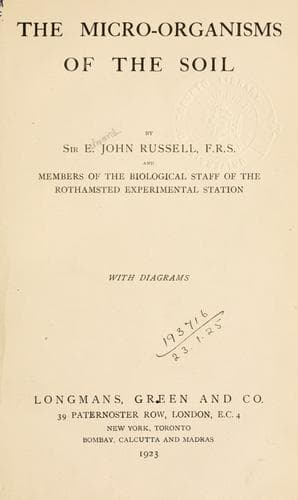
The micro-organisms of the soilRussell, Edward J. (Edward John)
Science
The micro-organisms of the soil
Russell, Edward J. (Edward John)
Soil microbiology
Furthermore, most artificial media are slight variations on a few
common and simple themes, and are very selective, permitting the growth
of a moiety only of the fungi present. In addition, many fungi grow
so slowly that they are overwhelmed by the more rapidly germinating
or spreading forms, or on the other hand, they may be eliminated by
the metabolic products of different adjacent colonies. The extremely
selective nature of the technique commonly used is shown if one
tabulates systematically all the fungi which have been recorded or
described in soil investigations. Of _Phycomycetes_ there are fifty-six
species of eleven genera; of _Ascomycetes_ twelve species of eight
genera; and of _Fungi imperfecti_, including _Actinomycetes_ but not
sterile _Mycelia_, 197 species of sixty-two genera. Rusts and Smuts
one might not expect, but that of the multitudes of _Basidiomycetes_
growing in wood and meadow not one should have been recorded is indeed
startling. It was at first thought that many imperfect fungi might
be conidial stages of _Basidiomycetes_, but much search among forms
isolated at Rothamsted has, up to the present, failed to reveal clamp
connections in the hyphæ.
Since various species of soil fungi have different optimum temperature,
humidity and other conditions[3] one would not expect to find an even
geographic distribution. Very little is yet known of this aspect, but
_Rhizopus nigricans_, _Mucor racemosus_, _Zygorrhynchus vuilleminii_,
_Aspergillus niger_, _Trichoderma koningi_, _Cladosporium herbarum_,
and many species of _Aspergillus_, _Penicillium_, _Fusarium_,
_Alternaria_, and _Cephalosporium_ have been commonly found throughout
North America and Europe wherever soils have been examined. Species of
_Aspergillus_, however, would appear to be more common in the soils
of south temperate regions and species of _Penicillium_, _Mucor_,
_Trichoderma_, and _Fusarium_ more abundant in northern soils.
It is well known that in many plant and animal communities there
occurs a definite rhythm, various species following each other in a
regular sequence as dominants in the population. Although it is not yet
possible to make any definite statement there would seem indications
that this may also be true of the soil fungi.
Public-domain text, read in full here on John Shaqi.
Reviews
Reviews
No reviews yet
Be the first to share your thoughts on this work.
Elsewhere in the archive
Join the Discussion
Join the discussion
Sign in to leave a comment or review.
Sign InorCreate an account