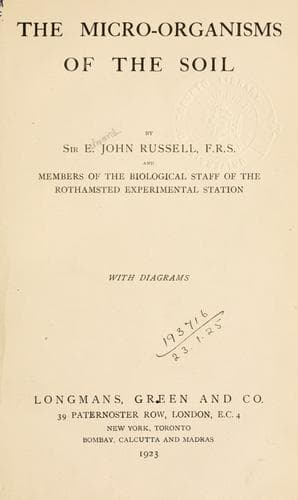
The micro-organisms of the soilRussell, Edward J. (Edward John)
Science
The micro-organisms of the soil
Russell, Edward J. (Edward John)
Soil microbiology
Much scattered information is available concerning the effect of
soil type, manuring, treatment, cropping, and so forth upon the
fungus content, but no clear issue as yet emerges from the results.
Hagem[8] found that cultivated soils vary greatly from forest soils
in the species of _Mucor_ present, and that certain species seem
to be associated in similar environments. Thus in pinewoods _Mucor
ramannianus_ is usually found, together with _M. strictus_, _M.
flavus_, and _M. sylvaticus_, and with this “_M. Ramannianus Society_,”
_M. racemosus_, _M. hiemalis_, and _Absidia orchidis_, are frequently
associated. The differences found by Hagem between the species of
_Mucor_ from forest and cultivated land could not, however, be
confirmed by Werkenthin.[26]
Dale,[5] examining sandy, chalky, peaty and black earth soils, found
specific differences, although many of the species were common to all.
A soil which had been manured continuously for thirty-eight years
with ammonium sulphate alone, contained twenty-two species, whereas
the same soil with the addition of lime only had thirteen species.
Both Goddard[7] and Werkenthin,[26] in their investigations, found
a constant and characteristic fungus flora regardless of soil type,
tillage, or manuring. Waksman’s[25] studies of forest soils showed
few species of _Mucor_ but many of _Penicillium_ and _Trichoderma_[2];
orchard soil contained no species of _Trichoderma_, very few of
_Penicillium_, but a large number of species of _Mucor_; species of
_Trichoderma_ were common in acid soils, whilst cultivated garden
soil contained all forms. The examination of very differently manured
plots on the Broadbalk wheat field at Rothamsted has not shown any
striking differences in the fungus flora, all the more important groups
of species being represented in every plot, but significant minor
differences are present. Thus, plot 13, manured with double ammonium
salts, superphosphate and sulphate of potash, is especially rich in
“species” of Trichoderma, whereas the unmanured plot contains large
numbers of species of green _Penicillium_, _Trichoderma_, and a species
of _Botrytis_ (pyramidalis?).
The effect of the crop upon the fungus flora is seen in cases where
the same crop is grown year after year as in certain flax areas, where
species of _Fusarium_ accumulate in the soil and tend to produce “flax
sickness.”[13]
QUANTITATIVE STUDY.
Public-domain text, read in full here on John Shaqi.
Reviews
Reviews
No reviews yet
Be the first to share your thoughts on this work.
Elsewhere in the archive
Join the Discussion
Join the discussion
Sign in to leave a comment or review.
Sign InorCreate an account