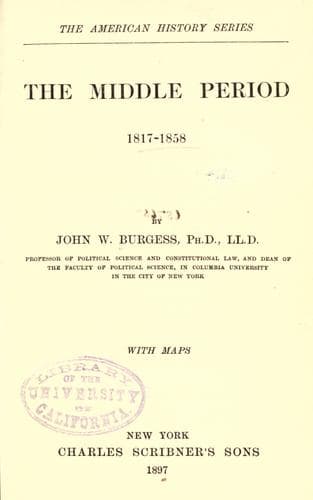
United States -- History -- 1815-1861; United States -- Politics and government -- 1815-1861
Senator Levi Woodbury, of New Hampshire, the leader of the Jackson
party in New Hampshire, endeavored, in the summer of 1829, to have
Jeremiah Mason, Mr. Webster's great friend, removed from the
presidency of the branch of the United States Bank at Portsmouth, N.
H., and Isaac Hill, another New Hampshire friend of the President,
attempted at the same time to have the United States pension agency,
connected with the Portsmouth branch of the United States Bank,
removed to Concord, and connected with a little bank there of which
Hill had been president, and in which he was still interested.
Jackson's Secretary of the Treasury, Mr. Ingham, asked Mr. Biddle, the
president of the United States Bank, to have Mason removed, and his
Secretary of War, Mr. Eaton, ordered Mason to transfer the pension
agency to Hill's bank in Concord. Mr. Biddle looked into the matter,
and being convinced that the whole thing was a political scheme,
refused to have Mason removed from office, and prevented the execution
of Eaton's order in regard to the transfer of the pension agency.
These are, very briefly stated, the facts upon which some of the
American historians found the theory that Jackson, entertaining no
opposition in principle to the Bank at the beginning of his
Administration, became so enraged at its managers, because of their
success in these petty bouts with his Cabinet officers, that he {192}
resolved upon its destruction. The treatment which Adams and Clay had
received at the hands of Jackson and his friends from 1824 onward had
led them to feel that Jackson's whole nature was full of personal
rancor, and that he could see nothing except from a personal point of
view. There is little doubt that this feeling largely determined
Adams' ideas of Jackson's attitude in the Bank question, and that the
historians have written the account of the Bank controversy under the
influence of Adams' representations.
[Sidenote: Jackson's opposition in principle to the Bank.]
There is undoubtedly some truth in this view of the matter, but it is
far from being the whole truth. It is not even that part of the truth
which is most valuable to the student of American history. There was
an opposition in principle to the United States Bank, as well as a
personal conflict between leaders in regard to it. That opposition in
principle was the opposition of "States' rights" democracy to
centralized privilege.
In all political systems there is a political science as well as a
public, or constitutional, law. The political science of a state is
based chiefly upon the actual social conditions and relations of its
population, and its public or constitutional law ought to be based
upon its political science. In fact, however, we seldom see social
conditions, political theory, and public law in a state of perfect
harmony. It is the prime problem of political and legal progress to
work out this great result.
[Sidenote: The political science of the Constitution of 1787.]
Public-domain text, read in full here on John Shaqi.
Reviews
Reviews
No reviews yet
Be the first to share your thoughts on this work.
Elsewhere in the archive
Join the Discussion
Join the discussion
Sign in to leave a comment or review.
Sign InorCreate an account