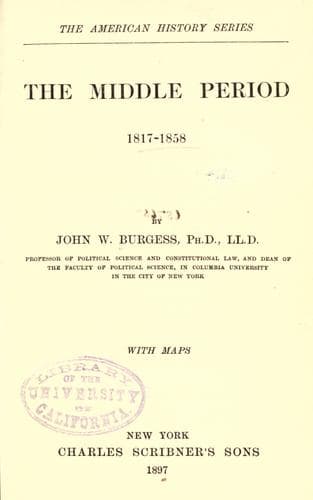
United States -- History -- 1815-1861; United States -- Politics and government -- 1815-1861
On the 21st of the month (January), Mr. Wilkins, the chairman of the
Judiciary committee of the Senate, reported from his committee the
bill for the collection of the revenue. This bill provided for
extending the jurisdiction of the Circuit Courts of the United States
over all cases in law or equity arising under the revenue laws of the
United States; for making all property taken or detained by any
officer or person under authority of any law of the United States
irrepleviable by any order or process of the tribunals of a
Commonwealth; for effecting the removal of suits commenced in a
Commonwealth court against any officer or person for any act done
under the laws of the United States, or on account of any right,
authority, or title claimed under those laws, to the Circuit Courts of
the United States, by means of proof laid before the Circuit Court
that the defendant had petitioned the Commonwealth court for the
removal of the cause. The bill provided, further, for substituting for
a copy of the record of the proceedings in the {234} Commonwealth
court, in case of the failure of that court to furnish a copy, an
affidavit, or other evidence, as the circumstances of the case might
require; for giving to the United States judges the power to grant
writs of habeas corpus in all cases where persons were in confinement
for acts done in pursuance of a law of the United States, or of an
order, process, or decree of any United States court or judge; for
empowering the United States marshals, under direction of the United
States judges, to provide places of confinement for persons arrested
or committed under the laws of the United States, where any
Commonwealth should refuse the use of its jails for the confinement of
such persons; for allowing the President to change the custom-house
from one place in a collection district to another, and to require the
duties to be paid in cash; and for empowering the President to use the
land and naval forces for suppressing any resistance to the execution
of the revenue laws too powerful to be overcome by the civil officers
of the general Government.
It was a good, stiff measure, but it was constitutional at every
point, and it was demanded by the exigencies of the situation. It was
a complete answer to the Replevin Act of South Carolina, and it would
inevitably throw the responsibility for committing the first act of
violence upon the Commonwealth in any resistance to the collection of
the duties. It pricked the bubble completely of South Carolina's
proposed legal resistance to the execution of the laws of the United
States.
Public-domain text, read in full here on John Shaqi.
Reviews
Reviews
No reviews yet
Be the first to share your thoughts on this work.
Elsewhere in the archive
Join the Discussion
Join the discussion
Sign in to leave a comment or review.
Sign InorCreate an account