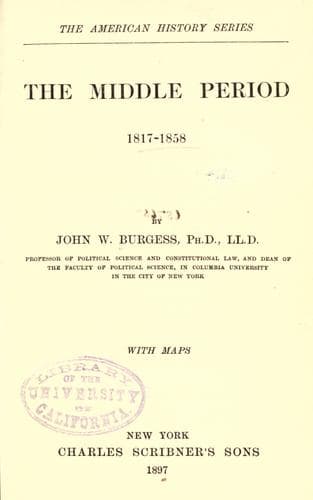
United States -- History -- 1815-1861; United States -- Politics and government -- 1815-1861
The opposition to the bill came from three quarters--from the
protectionists, who clung to the existing law, from the strong
nationalists, who were against any show of compromise with
nullification, and from the strict parliamentarians, who held that any
bill touching the tariff must originate in the House of
Representatives.
The protectionists were answered, and many of them won over, by the
argument that the Verplanck bill would pass if they did not accept Mr.
Clay's bill. The strong nationalists were told that if Congress should
pass the Wilkins bill before the Clay bill a sufficient vindication of
their position would be attained. They were inclined to accept that
view, but the South Carolinians set themselves against this order of
procedure with all their strength. Mr. Calhoun came forward again with
his "States' sovereignty" exposition of the Constitution, and
denounced the Wilkins bill in the most vehement language as "utterly
unconstitutional, as an attempt to enforce robbery by murder, an
attempt to decree the massacre of the citizens of South Carolina," and
declared that the citizens of South Carolina would, should it become
law, resist its execution "at every hazard, even that of death
itself."
{237} [Sidenote: Passage of the "Force Bill" by the Senate.]
On the following day Mr. Webster answered Mr. Calhoun's argument, and
demonstrated so clearly the nationality of the Constitution, the
supremacy of the laws of the United States, and the rebellious
character of nullification, that the Senate was convinced of the
necessity of passing the Wilkins bill before voting upon Mr. Clay's
bill. On the 20th of the month (February), the Senate passed the
Wilkins bill by a vote of thirty-two to one. The objections of the
strong nationalists to Mr. Clay's bill were now substantially
satisfied; but the high protectionists still held out in considerable
number for some modification of the bill in their favor, and on the
day after the passage of the Wilkins bill by the Senate, Mr. Clay
moved to amend his own bill by the proposition to base the duties on
home valuation instead of on the foreign invoice. The protectionists
were satisfied by this, but Mr. Calhoun immediately declared that
South Carolina would not accept the bill with this change. The
protectionists, in sufficient number to defeat the bill, declared that
they would not accept it without the change. Mr. Calhoun had at last
come to see the peril which lay in South Carolina's course, and to
understand the feeling of the nation toward her. He wisely concluded
to abandon his opposition to the amendment, and to vote for the bill.
[Sidenote: Passage of the Compromise Tariff bill and the "Force Bill"
by Congress.]
Public-domain text, read in full here on John Shaqi.
Reviews
Reviews
No reviews yet
Be the first to share your thoughts on this work.
Elsewhere in the archive
Join the Discussion
Join the discussion
Sign in to leave a comment or review.
Sign InorCreate an account