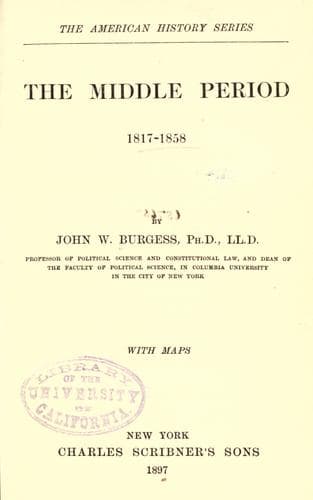
United States -- History -- 1815-1861; United States -- Politics and government -- 1815-1861
In the summer of 1830 the wave of revolution rolled again over Europe.
The rights of man, the brotherhood of man, and the sovereignty of the
people, were the principles which pressed again to the front. While no
actual connection can be established between the Revolution of 1830 in
Europe and the rise of Abolition in the United States, yet they belong
to the same period of time, and harmonize in principle. The impulses
which move the human race, or those parts of the human race which
stand upon the same plane of civilization, are not broken by mountain
heights or broad seas. Their manifestations appear spontaneously and
coetaneously in widely separated places.
Before 1830, indeed, as we have so often seen, slavery in the United
States had been regarded as a grievous evil by most of the great
spirits of the age and country, and schemes for gradual emancipation
had been invented, and, in some slight degree, had been put into {245}
operation. It was, however, the humanitarian outburst of 1830, and the
succeeding years, which represented slavery as a sin and a crime
against the universal principle of human liberty and the rights of
man, a sin which called for immediate expiation by instantaneous,
unqualified, and uncompensated abolition.
[Sidenote: The philosophy of Abolition.]
There is nothing strange about the philosophy of Abolition. It is
simply the idealistic view of the beginning and the progress of human
history. It assumes liberty as the original state of man, condemns
every species of modification of liberty suffered by any human being,
or any class of human beings, as resulting from the unrighteous act of
some other human being, or class or race of human beings, and demands
the immediate discontinuance of the tyranny as the only approximately
adequate satisfaction which can be made to those who have suffered
that tyranny. It is the orthodox, paradisaical view of the origin,
unity, and primal perfection of the human race. It is the literal
interpretation of the Declaration of Independence. It is
thorough-going, radical humanitarianism. Its political principle, in
the language of its chief exponent, was: "The world our country, and
all mankind our countrymen."
Over against it stands the pessimistic view of man and of
civilization, which divides the human race into the few intelligent
and good, and the great mass of the ignorant and vicious, and
considers the permanent subjection of the latter to the former as the
divinely constituted, and therefore the permanent, order of the world.
And between the two lies the true historical view, which regards
liberty, equality, and brotherhood as the products of civilization, as
the final, not the primal, status of the human race, and determines
the character of every stage of development from barbarism to {246}
civilization, not by its distance from the perfect condition, but by
the fact of its advance upon, or its retrogression from, the stage
immediately antecedent.
Public-domain text, read in full here on John Shaqi.
Reviews
Reviews
No reviews yet
Be the first to share your thoughts on this work.
Elsewhere in the archive
Join the Discussion
Join the discussion
Sign in to leave a comment or review.
Sign InorCreate an account