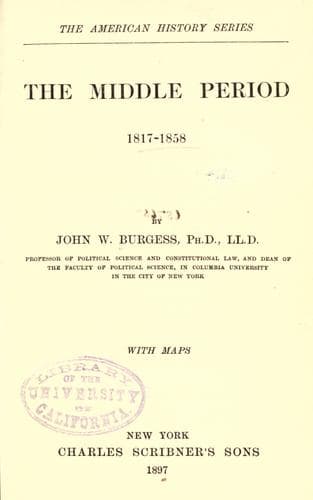
United States -- History -- 1815-1861; United States -- Politics and government -- 1815-1861
We may fairly say that the slaveholders in the more southern
Commonwealths sustained the Fugitive Slave {379} Law more out of
consideration for their brothers in the border Commonwealths than for
the sake of their own immediate interests, or from their own
convictions of its policy, while they would have greatly preferred the
restriction of slavery to the territory south of the line of
thirty-six degrees and thirty minutes to the Pacific, with some sort
of a guarantee of its existence there during the Territorial period,
to any chance of extending slavery north of that line by the repeal of
the prohibitions already existing. It is not at all surprising, in
view of this state of feeling in 1852, that, ten years later, the
Confederates considered themselves left in the lurch by the border
Commonwealths, in the support of whose views and interests they had
done so much to provoke the North to the contest.
{380}
CHAPTER XIX.
THE REPEAL OF THE MISSOURI COMPROMISE
The Connection of California with the Mississippi
Valley--Nebraska--Mr. Douglas' Nebraska Bill and Report--The
Surprising Assumptions in the Report--Mr. Douglas' Purpose--The Report
and Bill Together in Conflict with the Act of 1820--The New
Section--Mr. Dixon's Proposed Amendment--Mr. Blair's Letter in
Reference to Mr. Seward's Connection with Dixon's Proposition--Douglas
and Dixon--Mr. Douglas' New Bill--The Free-soil Protest Against the
Bill--Mr. Douglas' Reply to the Address--Mr. Chase's First Amendment
to the Bill--The Southern Whigs Aroused by Mr. Wade's Accusations--Mr.
Chase's Amendment Lost--Mr. Douglas' Last Change in the Wording of the
Clause--Mr. Everett's Views--Mr. Houston's Opposition to the Bill--Mr.
Bell's Attitude Toward the Bill--Mr. Douglas' Amendment Passed by the
Senate--Mr. Chase's Amendments--Mr. Bell's Argument Against the
Bill--Mr. Douglas' Final Argument--The Passage of the Kansas-Nebraska
Bill by the Senate--Analysis of the Vote Upon the Bill--Development of
Popular Opposition to the Bill--The Kansas-Nebraska Bill in the
House--The Relation of the Administration to the Bill--President
Pierce and Mr. Davis--The Bill Taken up in the Committee of the Whole
of the House of Representatives--Mr. A. H. Stephens' Management of the
Bill--The Bill Passed and Signed by the President--Analysis of the
Vote on the Bill in the House--What the Figures Taught--The
Kansas-Nebraska Act a Stupendous Fallacy.
When President Fillmore's last annual message to Congress was sent in,
on December 6th, 1852, the quiet of the country in regard to the
slavery question was more {381} complete than it had been since 1830.
The President did not even mention the subject. Evidently the people
believed that the Measures of 1850, and their cordial endorsement in
the elections just passed, had finally solved the great question, in
so far as the Congress could solve it at all. But never was there a
more deceptive peace. It was merely the dead calm before the dread
cyclone.
Public-domain text, read in full here on John Shaqi.
Reviews
Reviews
No reviews yet
Be the first to share your thoughts on this work.
Elsewhere in the archive
Join the Discussion
Join the discussion
Sign in to leave a comment or review.
Sign InorCreate an account