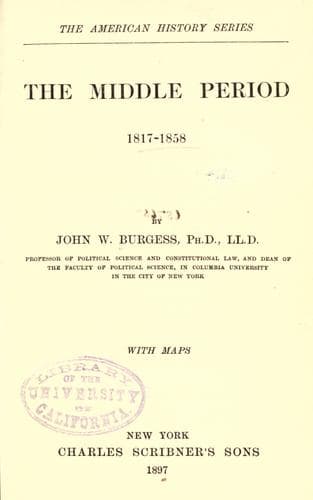
United States -- History -- 1815-1861; United States -- Politics and government -- 1815-1861
A few minutes before five o'clock on the morning of March 4th, after a
continuous session of seventeen hours, the vote upon the bill was
taken, resulting in thirty-seven voices in its favor and fourteen
against it. Eleven Senators had not voted. Of these, three sent word
that, if they could have been present, they would have voted for the
bill, and one that he would have voted against it. There were also two
vacancies at the moment, one in the Vermont delegation, and one in
that of North Carolina. This reduced the number of those who actually
refrained from voting, though present, to five. These gentlemen were
Mr. Everett, of Massachusetts, Mr. Wright, of New Jersey, Mr. Cooper,
of Pennsylvania, Mr. Clayton, of Delaware, and Mr. Pearce, of
Maryland, all Whigs with the exception of Mr. Wright.
[Sidenote: Analysis of the vote upon the bill.]
Counting the names of those who announced how they would have voted
had they been able to be present, and considering the Commonwealths in
whose delegations there were vacancies as represented fully by the one
{399} member from each, we may say that, in the Senate, New Hampshire,
Michigan, Indiana, Illinois, Iowa, California, Virginia, Kentucky,
Missouri, North Carolina, Arkansas, South Carolina, Georgia, Alabama,
Mississippi, Florida, and Louisiana voted for the bill; that Maine,
Vermont, Rhode Island, New York, Ohio, and Wisconsin voted against the
bill; that Connecticut, Tennessee, and Texas were divided; and that
Massachusetts, New Jersey, Pennsylvania, Delaware, and Maryland were
doubtful. Not a single Northern Whig voted for the bill, and only two
Northern Whigs failed to vote against it. One Southern Whig, Mr. Bell,
voted against it, and two Southern Whigs, Mr. Clayton and Mr. Pearce,
failed to vote for it. Every Southern Democrat, except only Mr.
Houston, voted for the bill, while, even if we count Mr. Chase and Mr.
Sumner as Democrats, only six Northern Democrats voted against it. The
bill may thus be fairly considered to have been a Western and Southern
measure, and a Democratic measure. The Western Democracy, with its
crude and radical notions about local self-government, invited the
South into a position which turned out to be a snare and a pitfall. It
is not meant by this that the Western Democracy was insincere, but
only that it was crude and vulgarly over self-confident. And it is not
meant that the South was insincere, but only too eager to vindicate
its honor and dignity, by obliterating the inequality with the North
in regard to the common territory of the Union, under which it fancied
it had suffered since the restriction placed upon slavery extension by
the Act of 1820.
[Sidenote: Development of popular opposition to the bill.]
Public-domain text, read in full here on John Shaqi.
Reviews
Reviews
No reviews yet
Be the first to share your thoughts on this work.
Elsewhere in the archive
Join the Discussion
Join the discussion
Sign in to leave a comment or review.
Sign InorCreate an account