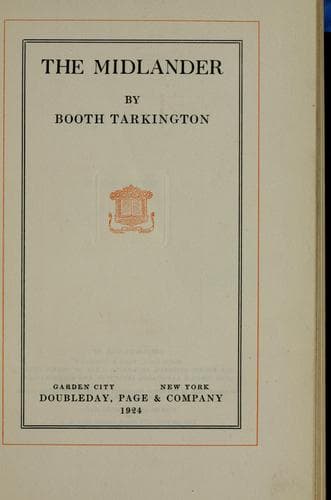
Middle West -- Fiction; Real estate developers -- Fiction; Suburbs -- Fiction
“Angry? No!” Mr. Shelby vociferated. “What in continental did _he_ have
to be angry about? _I_ was the one that was angry. He stood up there and
laughed and bragged about what he was goin’ to do till you’d thought
he’d bust with the gas of it! Why, Great Geemunently!—you’d thought
this whole city’s got nothin’ to do but turn in and run around doin’
what Ornaby Addition says it’s got to! I says, ‘Yes!’ I says. ‘So from
now on the tail’s goin’ to wag the dog, is it?’ ‘I don’t know but it
might,’ he says. ‘This town’s done considerable laughin’ at me,’ he
says. ‘I expect it’s about time I did some laughin’ myself,’ he says.
‘You’ll have to look out for your charter, Mr. Shelby,’ he says.”
Martha ventured to continue her naïveté, and unfortunately carried it
too far. “And _will_ you have to look out for it, papa?” she asked
gently.
With his thin but hard old fist he struck the table a blow that jarred
the china and jingled the silver. “Haven’t you got any _sense_?” he
shouted. “I’ll show him who he’s talkin’ to! There’s a _few_ men left in
this town that’ll teach him a little before he gets through with ’em!
I’m not the only one he thinks he can lay down the law to.” He glared at
her, his small gray face flushing with his increased anger. “Are _you_
still standin’ up for him after the way he’s treated you?”
This took Martha’s breath, and for an instant she was at a loss. Never
before had her father seemed to notice how she was “treated”—by
anybody. “I don’t know what you—I don’t know what you mean,” she said.
“Don’t you?” he returned sharply, and, before the bright stare of his
angry eyes, her own troubled gaze fell. “You say you don’t know what I
mean?”
“Why—no. Not—not at all,” she murmured.
“Well, _I_ do!” And with a brief shot of breath between his almost
closed lips, he further expressed an emotion that remained enigmatic to
her. He rose. “Seems to me it’s about time you quit standin’ up for
him,” he said; and stalked out of the room, leaving her still at the
table.
She sat there in an attitude of some rigidity after she had heard him go
upstairs, and she continued to sit there, though she had finished her
dinner before he departed. The conclusion she reached in her thoughts
was that there was a question she would never ask him;—she would never
ask him what he had meant by that final remark of his. She hoped he
meant only that her pride ought to resent a neighbour’s failure to come
to say he was glad to see her at home again—but she feared her father
meant more than this. She feared he meant much more, and she so feared
it that she would never dare to ask him.
Public-domain text, read in full here on John Shaqi.
Reviews
Reviews
No reviews yet
Be the first to share your thoughts on this work.
Elsewhere in the archive
Join the Discussion
Join the discussion
Sign in to leave a comment or review.
Sign InorCreate an account