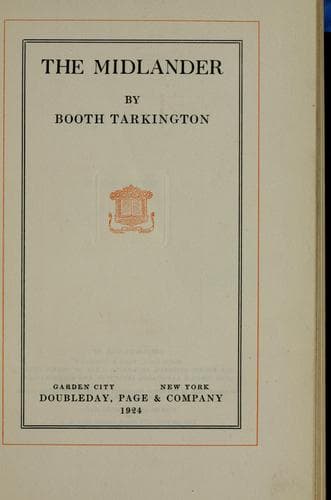
Middle West -- Fiction; Real estate developers -- Fiction; Suburbs -- Fiction
Surprised, Dan stared at him; and Mr. Oliphant gravely and
affectionately returned his look. “Yes, sir,” the son said awkwardly. “I
hope so. Thank you, sir.” And he thought that the handsome, kind old
face seemed whiter and more fragile than usual.
That was natural, Dan told himself; people couldn’t help growing old,
and they grew whiter and thinner as age came upon them; but age didn’t
necessarily mean ill-health. For that matter, his father hadn’t nearly
reached a really venerable old age; he was more than a decade younger
than old-hickory Shelby, who still never missed a day’s work.
Nevertheless, there had been something a little disquieting in Mr.
Oliphant’s manner; it was as if he had thought that perhaps he might
never have another chance to say what he had said;—and that night, on
the train to which he had hurried after their drive, Dan thought about
his father often.
He thought about him often, too, the next day, in New York; and during
the conferences there with the landscape architects who were designing
the new parks, his thoughts went uneasily westward;—not to the green
stretches of grove and sward that were to be, but to the quiet old man
who had walked so slowly between the tall white gateposts after bidding
his son good-bye. Recalling this, it seemed to Dan that he had never
before seen him walk so slowly; and he went over in his mind, for the
fiftieth time, his father’s manner in speaking of Lena—the slight,
timid insistence, as if there might never be another opportunity to say
something he had always wished to say. It had given what he said the air
of a blessing bestowed—and of a valedictory.
Thus Dan’s vague uneasiness grew, and although he scolded himself for
it, and told himself he was imaginative beyond reason, he could not be
rid of it. That was well for him; since such uneasiness may be of help
when life is like a path whereon tigers leap from nowhere, as it is,
sometimes;—the wayfarer will not avoid wounds, but may better survive
them for having been in some expectance of them.
For a year Mr. Oliphant’s heart had been “not just what it ought to be”;
but he told no one that this was his physician’s report to him. Harlan’s
telegram reached New York just as Dan was starting home. Mr. Oliphant
had indeed taken his last opportunity to say what he had so long wished
to say, for now the kind heart beat no longer;—but he had died proud of
his son.
CHAPTER XXV
NEITHER Mr. Oliphant’s daughter-in-law nor his grandson was at home at
the time of his death. Lena had gone abroad again, for a “three-months’
furlough,” as she called it; and again in spite of Dan’s vehement
protest that the boy “ought to see his own country first,” she had taken
Henry with her.
Public-domain text, read in full here on John Shaqi.
Reviews
Reviews
No reviews yet
Be the first to share your thoughts on this work.
Elsewhere in the archive
Join the Discussion
Join the discussion
Sign in to leave a comment or review.
Sign InorCreate an account