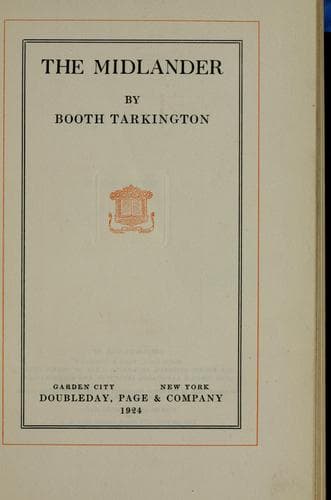
Middle West -- Fiction; Real estate developers -- Fiction; Suburbs -- Fiction
“You call it your patience, but it became only your habit long ago,” she
told him. “It would really unsettle you badly if I ever said I’d marry
you, Harlan; and it would unsettle you even more if I not only said I
would, but went ahead and did it. You’d find you’d never forgive me for
upsetting your routine. If we were married, where in the world would you
ever _go_? You haven’t been anywhere for so long, except to see me, that
you’d be left without the destination you’ve been accustomed to. It’s
gallant of you to still mention your willingness, every now and then,
and I own up that I rather expect it and should miss it if you didn’t;
but if you want to marry, you ought to look about for—well, say a
pretty widow of twenty-nine, Harlan. She’d be better for you than one of
the ‘buds,’ though you could have whichever you chose;—they’d jump at
the chance! The trouble with me is that I’m too old—and I’m horribly
afraid I look my age.”
The fear was warranted, though it need not have been a fear. She had
escaped the portliness that seemed to threaten her at thirty, and had
escaped too far, perhaps; but her thinness was not angular; and if she
looked her age, then that age was no more than a pleasantly responsible
age, as Harlan told her, and neither a careworn nor a gray-haired age.
In fact, it must be the perfect age, he said—and he wondered if it
mightn’t be as kind as it looked, and be the perfect age for him.
At that, she became more serious. “I’m surprised at myself every year I
grow older,” she said. “I’m so much more romantic than I was at twenty,
and it seems I keep growing more so. At twenty how I’d have laughed if
I’d heard of a woman of forty who said she couldn’t marry because she
was in love with no one! I suppose what would have struck me as funniest
would have been the idea of a woman of forty talking about marrying at
all.”
She was “in love with no one,” but she could still be Harlan’s brother’s
champion, if need arose; and after George McMillan took up his residence
in the town, and began his mild rivalry, she had this amiable bachelor
to second her. Moreover, it is to be admitted for her that she, who in
the bloom of youth had never known how to display the faintest symptoms
of coquetry, now sometimes enjoyed tokens of disturbance unwillingly
exhibited by Harlan when the rival appeared to win an advantage.
McMillan, dark and growing a little bald, counterbalanced what was
lacking above by a decoration below already rare in the land, but not
yet a curiosity, a Van Dyke beard, well suited to his face. In manner,
too, he was equal to the flavour of a fine old portrait, and he had
spoken from his childhood in the accent Harlan had carefully acquired.
Thus the latter was sometimes but too well encountered on his own
ground.
Public-domain text, read in full here on John Shaqi.
Reviews
Reviews
No reviews yet
Be the first to share your thoughts on this work.
Elsewhere in the archive
Join the Discussion
Join the discussion
Sign in to leave a comment or review.
Sign InorCreate an account