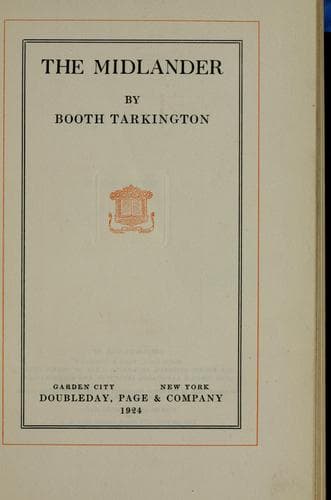
Middle West -- Fiction; Real estate developers -- Fiction; Suburbs -- Fiction
He had wanted it ever since Martha was a handsome romping girl of
fourteen and he a fastidious observer a little older. She was a romp,
yet her boyish romping never lacked a laughing charm; for, although she
was one of those big young girls who seem to grow almost overwhelmingly,
she had the fortunate gift of gracefulness; she was somehow able to be
large without ever being heavy. And one evening at a “German” for young
people of the age that begins to be fretful about a correct definition
of the word “children,” she danced lightly to Harlan and unexpectedly
“favoured” him; whereupon something profound straightway happened to the
boy’s emotions.
No visible manifestations betrayed the change within so self-contained a
youth; for here his pride, deep-set even then, was touched;—the lively
Martha’s too obvious preference was always for the brother so much more
of her own sort. Dan was her fellow-romp, and she would come shouting
under the Oliphants’ windows for him as if she were a boy. They were an
effervescent pair, and often rough in their horseplay with each other;
while Harlan, aloof and cold of eye, would watch them with an inward
protest so sharp that it made him ache.
He wanted to make Martha over from a model of his own devising; he
wished her to be more dignified, and could not understand her childish
love of what to him seemed mere senseless caperings with the boisterous
Dan. Yet neither her caperings nor her devotion to Dan was able to
disperse Harlan’s feeling for her, which gradually became a kind of
customary faint pain. In a little time—a year or two—the caperings
ceased; Martha went eastward, as did the brothers, for the acquisition
of a polish believed to be richer in that direction; and when she
returned she had become dignified, as Harlan wished, but otherwise did
not appear to be greatly altered. Certainly her devotion to Dan was the
same; and her merely becoming dignified failed to alleviate that
customary faint pain of Harlan’s. He still had it, and with it his long
mystification;—he had never been able to understand why she cared for
Dan.
Harlan’s view of his brother as a rather foolish person might have meant
no more than superiority’s tolerant amusement, had that pain and
mystification of his not been involved; but, as matters were, Harlan
would have been superior indeed if all bitterness had passed him by. He
could have submitted, though with a sorrowing perplexity, to Martha’s
inability to be in love with him; but what sometimes drove him to utter
a burst of stung laughter was the thought that she had given her heart
to a man who did not even perceive the gift. To Harlan that seemed to be
the supreme foolishness of his foolish brother.
Public-domain text, read in full here on John Shaqi.
Reviews
Reviews
No reviews yet
Be the first to share your thoughts on this work.
Elsewhere in the archive
Join the Discussion
Join the discussion
Sign in to leave a comment or review.
Sign InorCreate an account