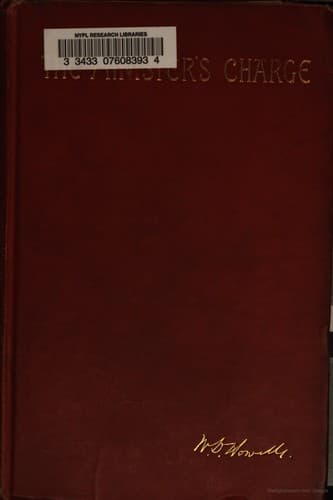
The Minister's Charge; Or, The Apprenticeship of Lemuel BarkerHowells, William Dean
General
The Minister's Charge; Or, The Apprenticeship of Lemuel Barker
Howells, William Dean
Boston (Mass.) -- Fiction; Clergy -- Fiction; Poets -- Fiction
Sewell laughed with him at his joke, and took what comfort he could from
the evidence of prosperity which Lemuel's new clothes offered. He argued
that if Barker could afford to buy them he could not be in immediate
need, and for some final encounter with him he trusted in Providence,
and was not too much cast down when his wife made him recognise that he
was trusting in Luck. It was an ordeal to look forward to finding Lemuel
sooner or later among his hearers every Sunday; but having prepared his
nerves for the shock, as men adjust their sensibilities to the recurrent
pain of a disease, he came to bear it with fortitude, especially as he
continually reminded himself that he had his fixed purpose to get at
Lemuel at last and befriend him in any and every possible way. He tried
hard to keep from getting a grudge against him.
At the hotel, Lemuel remained in much of his original belief in the
fashion and social grandeur of the ladies who formed the majority of
Mrs. Harmon's guests. Our womankind are prone to a sort of helpless
intimacy with those who serve them; the ladies had an instinctive
perception of Lemuel's trustiness, and readily gave him their confidence
and much of their history. He came to know them without being at all
able to classify them with reference to society at large, as of that
large tribe among us who have revolted from domestic care, and have
skilfully unseated the black rider who remains mounted behind the
husband of the average lady-boarder. Some of them had never kept house,
being young and newly married, though of this sort there were those who
had tried it in flats, and had reverted to their natural condition
of boarding. They advised Lemuel not to take a flat, whatever he did,
unless he wanted to perish at once. Other lady boarders had broken up
housekeeping during the first years of the war, and had been boarding
round ever since, going from hotels in the city to hotels in the
country, and back again with the change of the seasons; these mostly had
husbands who had horses, and they talked with equal tenderness of the
husbands and the horses, so that you could not always tell which Jim
or Bob was; usually they had no children, but occasionally they had a
married daughter, or a son who lived West. There were several single
ladies: one who seemed to have nothing in this world to do but to come
down to her meals, and another a physician who had not been able, in
embracing the medical profession, to deny herself the girlish pleasure
of her pet name, and was lettered in the list of guests in the entry as
Dr. Cissie Bluff. In the attic, which had a north-light favourable to
their work, were two girls, who were studying art at the Museum; one of
them looked delicate at first sight, and afterwards seemed merely very
gentle, with a clear-eyed pallor which was not unhealth. A student in
the Law School sat at the table with these girls, and seemed sometimes
to go with them to concerts and lectures. From his talk, which was
Public-domain text, read in full here on John Shaqi.
Reviews
Reviews
No reviews yet
Be the first to share your thoughts on this work.
Elsewhere in the archive
Join the Discussion
Join the discussion
Sign in to leave a comment or review.
Sign InorCreate an account