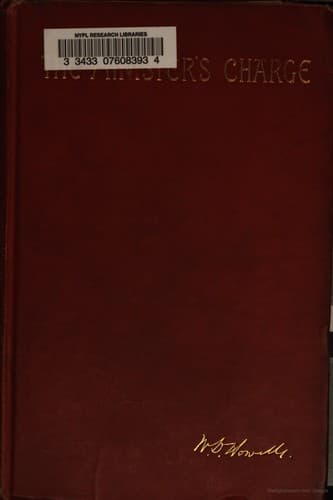
The Minister's Charge; Or, The Apprenticeship of Lemuel BarkerHowells, William Dean
General
The Minister's Charge; Or, The Apprenticeship of Lemuel Barker
Howells, William Dean
Boston (Mass.) -- Fiction; Clergy -- Fiction; Poets -- Fiction
After agreeing with his wife that he had better leave Barker alone,
Sewell did not feel easy in doing so. He had that ten-dollar note which
Miss Vane had given him, and though he did not believe, since Evans had
reported Barker's refusal of his fee, that the boy would take it, he was
still constrained to do something with it. Before giving it back to
her, he decided at least to see Barker and learn about his prospects and
expectations. He might find some way of making himself useful to him.
In a state of independence he found Lemuel much more accessible than
formerly, and their interview was more nearly amicable. Sewell said
that he had been delighted to hear of Lemuel's whereabouts from his old
friend Evans, and to know that they were housed together. He said that
he used to know Mrs. Harmon long ago, and that she was a good-hearted,
well-meaning woman, though without much forecast. He even assented to
Lemuel's hasty generalisation of her as a perfect lady, though they both
felt a certain inaccuracy in this, and Sewell repeated that she was
a woman of excellent heart and turned to a more intimate inquest of
Lemuel's life.
He tried to find out how he employed his leisure time, saying that he
always sympathised with young men away from home, and suggesting the
reading-room and the frequent lectures at the Young Men's Christian
Union for his odd moments. He learned that Lemuel had not many of these
during the week, and that on Sundays he spent all the time he could get
in hearing the different noted ministers. For the rest, he learned that
Lemuel was very much interested in the city, and appeared to be rapidly
absorbing both its present civilisation and its past history. He was
unsmilingly amused at the comments of mixed shrewdness and crudity which
Lemuel was betrayed into at times beyond certain limits of diffidence
that he had apparently set himself; at his blunders and misconceptions,
at the truth divined by the very innocence of his youth and
inexperience. He found out that Lemuel had not been at home since he
came to Boston; he had expected to go at Thanksgiving, but it came so
soon after he had got his place that he hated to ask; the folks were all
well, and he would send the kind remembrances which the minister asked
him to give his mother. Sewell tried to find out, in saying that Mrs.
Sewell and himself would always be glad to see him, whether Lemuel had
any social life outside of the St. Albans, but here he was sensible that
a door was shut against him; and finally he had not the courage to do
more about that money from Miss Vane than to say that from time to time
he had sums intrusted him, and that if Lemuel had any pressing need
of money he must borrow of him. He fancied he had managed that rather
delicately, for Lemuel thanked him without severity, and said he should
get along now, he guessed, but he was much obliged. Neither of them
mentioned Miss Vane, and upon the whole the minister was not sure that
Public-domain text, read in full here on John Shaqi.
Reviews
Reviews
No reviews yet
Be the first to share your thoughts on this work.
Elsewhere in the archive
Join the Discussion
Join the discussion
Sign in to leave a comment or review.
Sign InorCreate an account