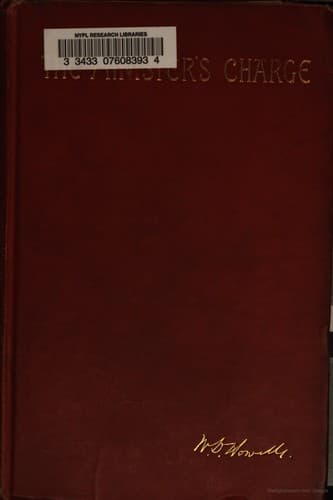
The Minister's Charge; Or, The Apprenticeship of Lemuel BarkerHowells, William Dean
General
The Minister's Charge; Or, The Apprenticeship of Lemuel Barker
Howells, William Dean
Boston (Mass.) -- Fiction; Clergy -- Fiction; Poets -- Fiction
'Manda Grier took Statira's part pretty sharply. She said it was one
thing to live out in a private family--that _was_ a disgrace, if you
could keep the breath of life in you any other way--and it was quite
another to wait in an hotel; and she did not want to have any one hint
round that she would let Statira demean herself. Lemuel was offended by
her manner, and her assumption of owning Statira. She defended him, but
he could not tell her how he had changed; the influences were perhaps
too obscure for him to have traced them all himself; after the first
time he had hardly mentioned the art-student girls to her. There were a
great many things that Statira could not understand. She had been much
longer in the city than Lemuel, but she did not seem to appreciate the
difference between that and the country. She dressed very stylishly; no
one went beyond her in that; but in many things he could see that she
remained countrified. Once on a very mild April evening, when they were
passing through the Public Garden, she wished him to sit on a vacant
seat they came to. All the others were occupied by young couples who sat
with their arms around each other.
“No, no!” shuddered Lemuel, “I don't want people should take you for one
of these servant-girls.”
“Why, Lem, how proud you're getting!” she cried with easy acquiescence.
“You're awfully stuck up! Well, then, you've got to take a horse-car; I
can't walk any further.”
XIX.
Lemuel had found out about the art-students from Berry. He said they
were no relation to each other, and had not even been acquainted before
they met at the art-school; he had first met them at the St. Albans.
Miss Swan was from the western part of the State, and Miss Carver from
down Plymouth way. The latter took pupils, and sometimes gave lessons at
their houses; she was, to Berry's thinking, not half the genius and not
half the duck that Miss Swan was, though she was a duck in her way too.
Miss Swan, as nearly as he could explain, was studying art for the fun
of it, or the excitement, for she was well enough off; her father was a
lawyer out there, and Berry believed that a rising son-in-law in his own
profession would be just the thing for the old man's declining years. He
said he should not be very particular about settling down to practice
at once; if his wife wanted to go to Europe a while, and kind of tender
foot it round for a year or two in the art-centres over there, he would
let the old man run the business a little longer; sometimes it did an
old man good. There was no hurry; Berry's own father was not excited
about his going to work right away; he had the money to run Berry and a
wife too, if it came to that; Miss Swan understood that. He had not told
her so in just so many words, but he had let her know that Alonzo W.
Berry, senior, was not borrowing money at two per cent. a month any
more. He said he did not care to make much of a blow about that part of
Public-domain text, read in full here on John Shaqi.
Reviews
Reviews
No reviews yet
Be the first to share your thoughts on this work.
Elsewhere in the archive
Join the Discussion
Join the discussion
Sign in to leave a comment or review.
Sign InorCreate an account