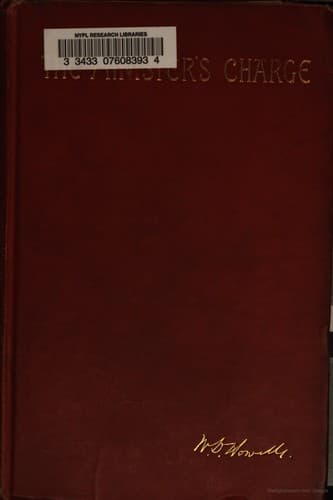
The Minister's Charge; Or, The Apprenticeship of Lemuel BarkerHowells, William Dean
General
The Minister's Charge; Or, The Apprenticeship of Lemuel Barker
Howells, William Dean
Boston (Mass.) -- Fiction; Clergy -- Fiction; Poets -- Fiction
He had no great pleasure in the reform he had effected. His heart was
not in it, except as waste and disorder and carelessness were painful
to him. He suffered to promote a better state of things, as many a
woman whose love is for books or pictures or society suffers for the
perfection of her housekeeping, and sacrifices her taste to achieve it.
He would have liked better to read, to go to lectures, to hear sermons;
with the knowledge of Mr. Evans's life as an editor and the incentive
of a writer near him, he would have liked to try again if he could not
write something, though the shame of his failure in Mr. Sewell's eyes
had burned so deep. Above all, since he had begun to see how city people
regarded the kind of work he had been doing, he would have liked to get
out of the hotel business altogether, if he could have been sure of any
other.
As the spring advanced his cares grew lighter. Most of the regular
boarders went away to country hotels and became regular boarders there.
Their places were only partially filled by transients from the South
and West, who came and went, and left Lemuel large spaces of leisure, in
which he read, or deputed Mrs. Harmon's nephew to the care of the office
and pursued his studies of Boston, sometimes with Mr. Evans,--whose
newspaper kept him in town, and who liked to prowl about with him,
and to frequent the odd summer entertainments,--but mostly alone. They
became friends after a fashion, and were in each other's confidence as
regarded their opinions and ideas, rather than their history; now and
then Evans dropped a word about the boy he had lost, or his wife's
health, but Lemuel kept his past locked fast in his breast.
The art-students had gone early in the summer, and Berry had left Boston
for Wyoming at the end of the spring term of the law-school. He had not
been able to make up his mind to pop before Miss Swan departed, but he
thought he should fetch it by another winter; and he had got leave to
write to her, on condition, he said, that he should conduct the whole
correspondence himself.
Miss Carver had left Lemuel dreaming of her as an ideal, yet true, with
a slow, rustic constancy, to Statira. For all that had been said and
done, he had not swerved explicitly from her. There was no talk of
marriage between them, and could not be; but they were lovers still,
and when Miss Carver was gone, and the finer charm of her society
was unfelt, he went back to much of the old pleasure he had felt in
Statira's love. The resentment of her narrow-mindedness, the shame for
her ignorance passed; the sense of her devotion remained.
Public-domain text, read in full here on John Shaqi.
Reviews
Reviews
No reviews yet
Be the first to share your thoughts on this work.
Elsewhere in the archive
Join the Discussion
Join the discussion
Sign in to leave a comment or review.
Sign InorCreate an account