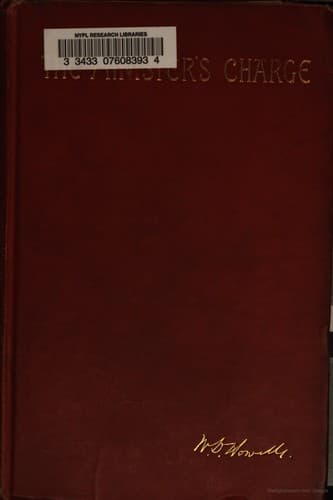
The Minister's Charge; Or, The Apprenticeship of Lemuel BarkerHowells, William Dean
General
The Minister's Charge; Or, The Apprenticeship of Lemuel Barker
Howells, William Dean
Boston (Mass.) -- Fiction; Clergy -- Fiction; Poets -- Fiction
He went back to his elevator, and Lemuel sat down at his desk, and
dropped his face upon his arms there. Toward eleven o'clock Evans came
in and looked at him, but without speaking; he must have concluded that
he was asleep; he went upstairs, but after a while he came down again
and stopped again at the office door, and looked in on the haggard boy,
hesitating as if for the best words. “Barker, Mr. Berry has been telling
me about your difficulty here. I know all about you--from Mr. Sewell.”
Lemuel stared at him. “And I will stand your friend, whatever people
think. And I don't blame you for not wanting to be beaten by that
ruffian; you could have stood no chance against him; and if you had
thrashed him it wouldn't have been a great triumph.”
“I wish he had killed me,” said Lemuel from his dust-dry throat.
“Oh no; that's foolish,” said the elder, with patient, sad kindness.
“Who knows whether death is the end of trouble? We must live things
down, not die them down.” He put his arm caressingly across the boy's
shoulder.
“I can never live this down,” said Lemuel. He added passionately, “I
wish I could die!”
“No,” said Evans. “You must cheer up. Think of next Saturday. It will
soon be here, and then you'll be astonished that you felt so bad on
Tuesday.”
He gave Lemuel a parting pressure with his arm, and turned to go
upstairs.
At the same moment the figure of Mrs. Harmon's nephew, distracted,
violent, burst up through the door leading to the basement.
“Good heavens!” exclaimed the editor, “is Mr. Harmon going to kick?”
“The house is on fire!” yelled the apparition.
A thick cloud of smoke gushed out of the elevator-shaft, and poured
into the hall, which it seemed to fill instantly. It grew denser, and
in another instant a wild hubbub began. The people appeared from every
quarter and ran into the street, where some of the ladies began calling
up at the windows to those who were still in their rooms. A stout little
old lady came to an open window, and paid out hand over hand a small
cable on which she meant to descend to the pavement; she had carried
this rope about with her many years against the exigency to which she
was now applying it. Within, the halls and the stairway became the scene
of frantic encounter between wives and husbands rushing down to save
themselves, and then rushing back to save their forgotten friends. Many
appeared in the simple white in which they had left their beds, with the
addition of such shawls or rugs as chance suggested. A house was opened
to the fugitives on the other side of the street, and the crowd that had
collected could not repress its applause when one of them escaped from
the hotel-door and shot across. It applauded impartially men, women, and
children, and, absorbed in the spectacle, no one sounded the fire-alarm;
the department began to be severely condemned among the bystanders
before the engines appeared.
Public-domain text, read in full here on John Shaqi.
Reviews
Reviews
No reviews yet
Be the first to share your thoughts on this work.
Elsewhere in the archive
Join the Discussion
Join the discussion
Sign in to leave a comment or review.
Sign InorCreate an account