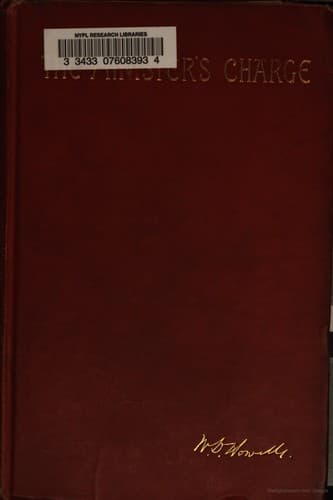
The Minister's Charge; Or, The Apprenticeship of Lemuel BarkerHowells, William Dean
General
The Minister's Charge; Or, The Apprenticeship of Lemuel Barker
Howells, William Dean
Boston (Mass.) -- Fiction; Clergy -- Fiction; Poets -- Fiction
He refused, at first kindly, and at last angrily; and he would have
gone away in this mood if Statira had not said that she would never say
another word to him about it, and hung upon his neck, while 'Manda Grier
looked on in sullen resentment. He came away sick and heavy at heart.
He said to himself that they would be willing to drag him into the mire;
they had no pride; they had no sense; they did not know anything and
they could not learn. He tried to get away from them to Miss Carver in
his thoughts; but the place where he had left her was vacant, and he
could not conjure her back. Out of the void, he was haunted by a look of
grieving reproach and wonder from her eyes.
XXV.
That evening Sewell went to see an old parishioner of his who lived on
the Hill, and who among his eccentricities had the habit of occupying
his city house all summer long, while his family flitted with other
people of fashion to the seashore. That year they talked of taking a
cottage for the first time since they had sold their own cottage at
Nahant, in a day of narrow things now past. The ladies urged that he
ought to come with them, and not think of staying in Boston now that he
had a trouble of the eyes which had befallen him, and Boston would be so
dull if he could not get about freely and read as usual.
He answered that he would rather be blind in Boston than telescopic at
Beverly, or any other summer resort; and that as for the want of proper
care, which they urged, he did not think he should lack in his own
house, if they left him where he could reach a bell. His youngest
daughter, a lively little blonde, laughed with a cousin of his wife's
who was present, and his wife decorously despaired. The discussion of
the topic was rather premature, for they were not thinking of going to
Beverly before middle of May, if they took the cottage; but an accident
had precipitated it, and they were having it out, as people do, each
party in the hope that the other would yield if kept at long enough
before the time of final decision came.
“Do you think,” said the husband and father, who looked a whimsical
tyrant at the worst, but was probably no easier to manage for his
whimsicality, “that I am going to fly in the face of prosperity, and
begin to do as other people wish because I'm pecuniarily able to do as I
please?”
The little blonde rose decisively from the low chair where she had been
sitting. “If papa has begun to reason about it, we may as well yield
the point for the present, mamma. Come, Lily! Let us leave him to Cousin
Charles.”
“Oh, but I say!” cried Cousin Charles, “if I'm to stay and fight it out
with him, I've got to know which side I'm on.”
“You're on the right side,” said the young lady over her shoulder; “you
always are, Cousin Charles.”
Public-domain text, read in full here on John Shaqi.
Reviews
Reviews
No reviews yet
Be the first to share your thoughts on this work.
Elsewhere in the archive
Join the Discussion
Join the discussion
Sign in to leave a comment or review.
Sign InorCreate an account