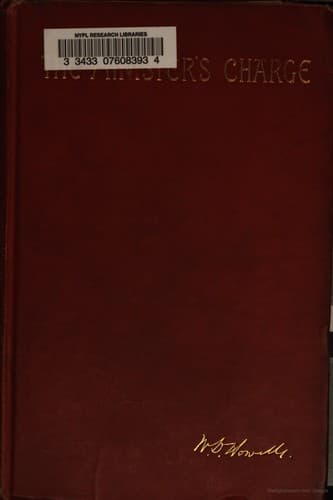
The Minister's Charge; Or, The Apprenticeship of Lemuel BarkerHowells, William Dean
General
The Minister's Charge; Or, The Apprenticeship of Lemuel Barker
Howells, William Dean
Boston (Mass.) -- Fiction; Clergy -- Fiction; Poets -- Fiction
He wondered at first that neither of those young ladies read to their
father, not knowing the disability for mutual help that riches bring.
Later, he saw how much Miss Lily Corey was engrossed with charity and
art, and how constantly Miss Nannie Corey was occupied with social
cares, and was perpetually going and coming in their performance. Then
he saw that they could not have rendered nor their father have received
from his family the duty which he was paid to do, as they must have done
if they had been poorer. But they were all fond of one another, and the
father had a way of joking with his daughters, especially the youngest;
and they talked with a freedom of themselves which puzzled Lemuel. It
appeared from what they said at different times that they had not always
been so rich, or that they had once had money, and then less, and now
much more. It appeared also that their prosperity was due to a piece of
luck, and that the young Mr. Corey, whom they expected in the summer,
had brought it about. His father was very proud of him, and, getting
more and more used to Lemuel's companionship, he talked a great deal
about his Tom, as he called him, and about Tom's wife, and his wife's
family, who were somehow, Lemuel inferred, not all that his own family
could wish them, but very good people. Once when Mr. Corey was talking
of them, Mrs. Corey came in upon them, and seemed to be uneasy, as if
she thought he was saying too much. But the daughters did not seem to
care, especially the youngest.
He found out that Mr. Corey used to be a painter, and had lived a long
time in Italy when he was young, and he recalled with a voluptuous
thrill of secrecy that Williams had once been in Italy. Mr. Corey
seemed to think better of it than Williams; he liked to talk of Rome and
Florence, and of Venice, which Williams had said was a kind of hole. The
old man said this or that picture was of this or that school, and vague
lights of knowledge and senses of difference that flattered Lemuel's
intellectual vanity stole in upon him. He began to feel that the things
Mr. Corey had lived for were the great and high objects of life.
Public-domain text, read in full here on John Shaqi.
Reviews
Reviews
No reviews yet
Be the first to share your thoughts on this work.
Elsewhere in the archive
Join the Discussion
Join the discussion
Sign in to leave a comment or review.
Sign InorCreate an account