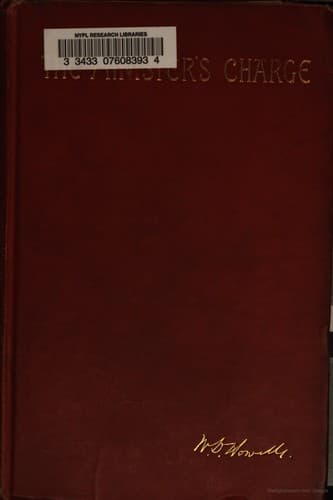
The Minister's Charge; Or, The Apprenticeship of Lemuel BarkerHowells, William Dean
General
The Minister's Charge; Or, The Apprenticeship of Lemuel Barker
Howells, William Dean
Boston (Mass.) -- Fiction; Clergy -- Fiction; Poets -- Fiction
“No, St'ira, I didn't. You never was hard to anybody, and the meanest
old iceberg in creation couldn't hate you.”
“Then you think he does care for me?”
“Yes.”
“And you know he'll come soon?”
“Yes.”
“To-morrow?”
“Yes, to-morrow.”
“O'Manda, O'Manda!”
XXX.
Lemuel had promised himself that if he could gain a little time he
should be able better to decide what it was right for him to do. His
heart lifted as he dropped the letter into the box, and he went through
the chapters which Mr. Corey asked him to read, after he came in, with
an ease incredible to himself. In the morning he woke with a mind that
was almost cheerful. He had been honest in writing that letter, and so
far he had done right; he should keep his word about going soon to
see Statira, and that would be honest too. He did not look beyond this
decision, and he felt, as we all do, more or less vaguely when we have
resolved to do right, that he had the merit of a good action.
Statira showed herself so glad to see him that he could not do less than
seem to share her joy in their making-up, as she called it, though he
insisted that there had been no quarrel between them; and now there
began for him a strange double life, the fact of which each reader must
reject or accept according to the witness of his own knowledge.
He renewed as far as he could the old warmth of his feeling for Statira,
and in his compunction experienced a tenderness for her that he had not
known before, the strange tenderness that some spirits feel for those
they injure. He went oftener than ever to see her, he was very good to
her, and cheered her with his interest in all her little interests;
he petted her and comforted her; but he escaped from her as soon as he
could, and when he shut her door behind him he shut her within it. He
made haste to forget her, and to lose himself in thoughts that were
never wholly absent even in her presence. Sometimes he went directly
from her to Jessie, whose innocent Bohemianism kept later hours, and who
was always glad to see him whenever he came. She welcomed him with talk
that they thought related wholly to the books they had been reading,
and to the things of deep psychological import which they suggested. He
seldom came to her without the excuse of a book to be lent or borrowed;
and he never quitted her without feeling inspired with the wish to
know more, and to be more; he seemed to be lifted to purer and clearer
regions of thought. She received him in the parlour, but their evenings
commonly ended in her little studio, whither some errand took them, or
some intrusion of the other boarders banished them. There he read to her
poems or long chapters out of the essayists or romancers; or else they
sat and talked about the strange things they had noticed in themselves
that were like the things they found in their books. Once when they had
talked a long while in this strain, he told how when he first saw her he
thought she was very proud and cold.
Public-domain text, read in full here on John Shaqi.
Reviews
Reviews
No reviews yet
Be the first to share your thoughts on this work.
Elsewhere in the archive
Join the Discussion
Join the discussion
Sign in to leave a comment or review.
Sign InorCreate an account