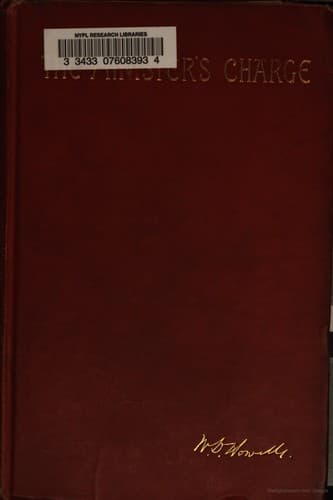
The Minister's Charge; Or, The Apprenticeship of Lemuel BarkerHowells, William Dean
General
The Minister's Charge; Or, The Apprenticeship of Lemuel Barker
Howells, William Dean
Boston (Mass.) -- Fiction; Clergy -- Fiction; Poets -- Fiction
She met Lemuel not unkindly, for she was a kind-hearted woman; but she
placed duty before charity even, and she could not help making him feel
that she was there in the discharge of a duty. She explained that Mr.
Sewell was very unusually busy that evening, and had sent her in his
place, and hoped soon to see him. She bade Lemuel sit down, and he
obeyed, answering all the questions as to the summer and his occupations
and health, and his mother's health, which she put to him in proof of
her interest in him; in further evidence of it, she gave him an account
of the Sewell family's doings since they last met. He did not stay long,
and she returned slowly and pensively to her husband.
“Well?” he asked, without looking round.
“Well; it's all right,” she answered, with rather a deep breath. “He
didn't seem to have come for anything in particular; I told him that if
he wished specially to speak with you, you would come down.”
Sewell went on with his writing, and after a moment his wife said, “But
you must go and see him very soon, David; you must go to-morrow.”
“Why?”
“He looks wretchedly, though he says he's very well. It made my heart
ache. He looks perfectly wan and haggard. I wish,” she burst out, “I
wish I had let you go down and see him!”
“Why--why, what was the matter?” asked Sewell, turning about now. “Did
you think he had something on his mind?”
“No, but he looked fairly sick. Oh, I wish he had never come into our
lives!”
“I'm afraid he hasn't got much good from us,” sighed the minister. “But
I'll go round and look him up in the morning. His trouble will keep
overnight, if it's a real trouble. There's that comfort, at least. And
now, do go away, my dear, and leave me to my writing.”
Mrs. Sewell looked at him, but turned and left him, apparently reserving
whatever sermon she might have in her mind till he should have finished
his.
The next morning he went to inquire for Lemuel at Mr. Corey's. The man
was sending him away from the door with the fact merely that Lemuel was
not then in the house, when the voice of Mr. Corey descending the stairs
called from within: “Is that you, Sewell? Don't go away! Come in!”
The old gentleman took him into the library and confessed in a bit of
new slang, which he said was delightful, that he was all balled up by
Lemuel's leaving him, and asked Sewell what he supposed it meant.
“Left you? Meant?” echoed Sewell.
When they got at each other it was understood that Lemuel, the day
before, had given up his employment with Mr. Corey, expressing a fit
sense of all his kindness and a fit regret at leaving him, but alleging
no reasons for his course; and that this was the first that Sewell knew
of the affair.
“It must have been that which he came to see me about last night,” he
said, with a sort of anticipative remorse. “Mrs. Sewell saw him--I was
busy.”
Public-domain text, read in full here on John Shaqi.
Reviews
Reviews
No reviews yet
Be the first to share your thoughts on this work.
Elsewhere in the archive
Join the Discussion
Join the discussion
Sign in to leave a comment or review.
Sign InorCreate an account