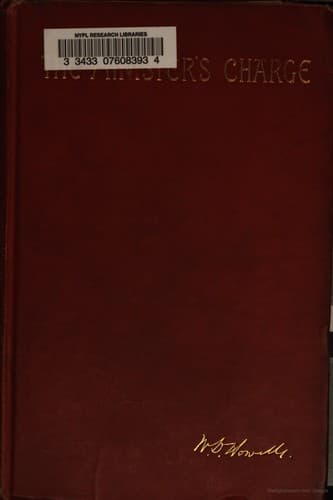
The Minister's Charge; Or, The Apprenticeship of Lemuel BarkerHowells, William Dean
General
The Minister's Charge; Or, The Apprenticeship of Lemuel Barker
Howells, William Dean
Boston (Mass.) -- Fiction; Clergy -- Fiction; Poets -- Fiction
“If that sort of thing is to go on,” said Corey, “what is to become of
the ancestry of the future _élite_ of Boston? I counted upon Barker to
found one of our first families. Besides, any Irishman could take his
farm and do better with it. The farm would be meat to the Irishman, and
poison to Barker, now that he's once tasted town.”
“Yes, I know all that,” said Sewell sadly. “I once thought the greatest
possible good I could do Barker, after getting him to Boston, was to get
him back to Willoughby Pastures; but if that was ever true, the time is
past. Now, it merely seems the only thing possible. When he gets well,
he will still have an invalid wife on his hands; he must provide her a
home; she could have helped him once, and would have done so, I've no
doubt; but now she must be taken care of.”
“Look here!” said Bellingham. “What's the reason these things can't be
managed as they are in the novels? In any well-regulated romance that
cough of hers would run into quick consumption and carry Barker's
fiancee off in six weeks; and then he could resume his career of
usefulness and prosperity here, don't you know. He could marry some one
else, and found that family that Corey wants.”
They all laughed, Sewell ruefully.
“As it is,” said Corey, “I suppose she'll go on having hemorrhages to a
good old age, and outlive him, after being a clog and burden to him all
his life. Poor devil! What in the world possesses him to want to marry
her? But I suppose the usual thing.”
This gave Sewell greater discomfort than the question of Lemuel's
material future. He said listlessly, “Oh, I suppose so,” but he was
far from thinking precisely that. He had seen Lemuel and the young girl
together a great deal, and a painful misgiving had grown up in his mind.
It seemed to him that while he had seen no want of patience and kindness
towards her in Lemuel, he had not seen the return of her fondness,
which, silly as it was in some of its manifestations, he thought he
should be glad of in him. Yet he was not sure. Barker was always so
self-contained that he might very well feel more love for her than he
showed; and, after all, Sewell rather weakly asked himself, was the love
so absolutely necessary?
When he repeated this question in his wife's presence, she told him she
was astonished at him.
“You know that it is _vitally_ necessary! It's all the more necessary,
if he's so superior to her, as you say. I can't think what's become of
your principles, my dear!”
“I do, you've got them,” said Sewell.
“I really believe I have,” said his wife, with that full conviction of
righteousness which her sex alone can feel. “I have always heard you
say that marriage without love was not only sinful in itself, but the
beginning of sorrow. Why do you think now that it makes no difference?”
Public-domain text, read in full here on John Shaqi.
Reviews
Reviews
No reviews yet
Be the first to share your thoughts on this work.
Elsewhere in the archive
Join the Discussion
Join the discussion
Sign in to leave a comment or review.
Sign InorCreate an account