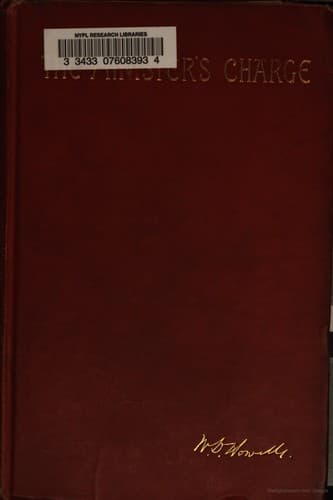
The Minister's Charge; Or, The Apprenticeship of Lemuel BarkerHowells, William Dean
General
The Minister's Charge; Or, The Apprenticeship of Lemuel Barker
Howells, William Dean
Boston (Mass.) -- Fiction; Clergy -- Fiction; Poets -- Fiction
Sewell knew that this emotion was largely the physical optimism of
convalescence; but he could not refuse the comfort it gave him to find
Barker in such a mood, and he did not conceive it his duty to discourage
it. Lofty ideals, if not indulged at the expense of lowly realities, he
had never found hurtful to any; and it was certainly better for Barker
to think too well than too ill of Boston, if it furnished him incentives
to unselfish living. He could think of enough things in the city to
warrant a different judgment, but if Barker's lesson from his experience
there was this, Sewell was not the person to weaken its force with him.
He said, with a smile of reserved comment, “Well, perhaps you'll be
coming back to us, some day.”
“I don't look forward to that,” said Lemuel soberly; and then his face
took a sterner cast, as if from the force of his resolution. “The first
thing I've got to do after I've made a home for her is to get Statira
away from the town where she can have some better air, and see if she
can't get her health back. It'll be time enough to talk of Boston again
when she's fit to live here.”
The minister's sympathetic spirit sank again. But his final parting with
Barker was not unhopeful. Lemuel consented to accept from him a small
loan, to the compass of which he reduced the eager bounty of Miss Vane
and Mr. Corey, representing that more would be a burden and an offence
to Barker. Statira and his mother came with him to take leave of the
Sewells.
They dismounted from the horse-car at the minister's door; and he saw,
with sensibility, the two women helping Lemuel off; he walked with a
cane, and they went carefully on either side of him. Sewell hastened
to meet them at the door himself, and he was so much interested in the
spectacle of this mutual affection that he failed at first to observe
that Mrs. Barker wore the skirts of occidental civilisation instead of
the bloomers which he had identified her with.
Public-domain text, read in full here on John Shaqi.
Reviews
Reviews
No reviews yet
Be the first to share your thoughts on this work.
Elsewhere in the archive
Join the Discussion
Join the discussion
Sign in to leave a comment or review.
Sign InorCreate an account