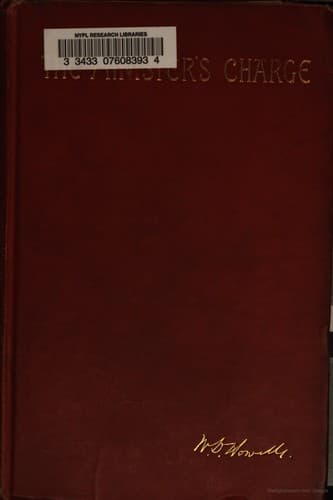
The Minister's Charge; Or, The Apprenticeship of Lemuel BarkerHowells, William Dean
General
The Minister's Charge; Or, The Apprenticeship of Lemuel Barker
Howells, William Dean
Boston (Mass.) -- Fiction; Clergy -- Fiction; Poets -- Fiction
Sewell did not know what to think. Would this dependence warm her
betrothed to greater tenderness than he now showed, or would its excess
disgust him? He was not afraid that Lemuel would ever be unkind to
her; but he knew that in marriage kindness was not enough. He looked
at Lemuel, serious, thoughtful, refined in his beauty by suffering; and
then his eye wandered to Statira's delicate prettiness, so sweet,
so full of amiable cheerfulness, so undeniably light and silly. What
chiefly comforted him was the fact of an ally whom the young thing
had apparently found in Lemuel's mother. Whether that grim personage's
ignorant pride in her son had been satisfied with a girl of Statira's
style and fashion, and proven capableness in housekeeping, or whether
some fancy for butterfly prettiness lurking in the fastnesses of the old
woman's rugged nature had been snared by the gay face and dancing eyes,
it was apparent that she at least was in love with Statira. She allowed
herself to be poked about and rearranged as to her shawl and the
narrow-brimmed youthful hat which she wore on the peak of her skull, and
she softened to something like a smile at the touch of Statira's quick
hands.
They had all come rather early to make their parting visit at the
Sewells, for the Barkers were going to take the two o'clock train for
Willoughby Pastures, while Statira was to remain in Boston till he could
make a home for her. Lemuel promised to write, as soon as he should be
settled, and tell Sewell about his life and his work; and Sewell, beyond
earshot of his wife, told him he might certainly count upon seeing them
at Willoughby in the course of the next summer. They all shook hands
several times. Lemuel's mother gave her hand from under the fringe of
her shawl, standing bolt upright at arm's-length off, and Sewell said it
felt like a collection of corn-cobs.
XXXV.
“Well?” said Sewell's wife, when they were gone.
“Well,” he responded; and after a moment he said, “There's this comfort
about it which we don't always have in such cases: there doesn't seem to
be anybody else. It would be indefinitely worse if there were.”
“Why, of course. What in the world are you thinking about?”
“About that foolish girl who came to me with her miserable love-trouble.
I declare, I can't get rid of it. I feel morally certain that she went
away from me and dismissed the poor fellow who was looking to her love
to save him.”
“At the cost of some other poor creature who'd trusted and believed in
him till his silly fancy changed? I hope for the credit of women that
she did. But you may be morally certain she did nothing of the kind.
Girls don't give up all their hopes in life so easily as that. She might
think she would do it, because she had read of such things, and thought
it was fine, but when it came to the pinch, she wouldn't.”
“I hope not. If she did she would commit a great error, a criminal
error.”
Public-domain text, read in full here on John Shaqi.
Reviews
Reviews
No reviews yet
Be the first to share your thoughts on this work.
Elsewhere in the archive
Join the Discussion
Join the discussion
Sign in to leave a comment or review.
Sign InorCreate an account