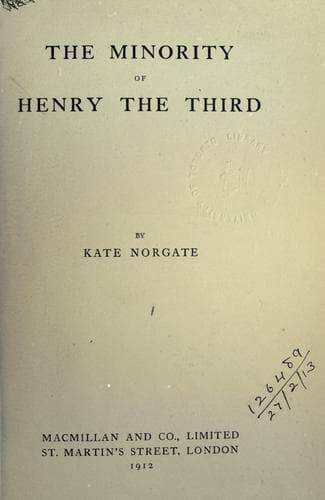
Great Britain -- History -- Henry III, 1216-1272; Henry III, King of England, 1207-1272
before the King and council the affairs of the King’s land in Ireland,
and”--thus he wrote to his “very dear friend” Hubert de Burgh--“they
may be settled by the counsel of yourself and other of the King’s
faithful men and of our friends.”[595]
The settlement took the form of a convention between the King and
Geoffrey, drawn up at Oxford on 11th August, in presence of the Legate
and the Archbishop of Dublin, as well as Peter des Roches, Hubert
de Burgh, and other members of the royal council. The Justiciar is
in future to answer at the King’s Exchequer in Dublin for escheats,
wards, fines, gifts, tallages, reliefs, and aids, from Ireland; and
the proceeds of all these, after they have been accounted for at the
Exchequer, are to be rendered to the King at his command. Out of the
assessed revenue of Ireland, and its “reasonable perquisites” other
than those above mentioned, the Justiciar is to maintain the garrisons
of the King’s land and castles in Ireland; the garrisons to be such as
shall be determined by the advice of Archbishop Henry, Thomas FitzAdam,
and Richard de Burgh. The surplus of these revenues and perquisites
shall be accounted for at the Dublin Exchequer by the view of these
three persons; and clerks of the King, appointed for the purpose, shall
keep a counter-roll of all these things. The Justiciar shall appoint as
constables of the King’s castles loyal and fit men who shall swear to
keep the castles faithfully and safely for the King, so that in case of
the Justiciar’s capture, or death, or misconduct, the castles shall be
safe; and these constables shall give hostages for their fidelity to
the Archbishop of Dublin and the Earl Marshal, and shall also send to
the King, through the Archbishop, charters of fealty. The Justiciar
gave his two sons as hostages; the Earl Marshal stood pledge for him;
and he himself further pledged the whole of his lands, to fall in to
the King and the Marshal respectively (he held some of each), in case
of his failure to keep faith. He also took an oath to keep all these
promises, on pain of being excommunicated by the Archbishop of Dublin
in case of breaking them; and as he had left his seal in Ireland for
legal purposes there, this writing was at his request sealed with the
seals of his brother William and of the Archbishop of Dublin, until he,
Geoffrey, could put his own seal to it.[596]
Public-domain text, read in full here on John Shaqi.
Reviews
Reviews
No reviews yet
Be the first to share your thoughts on this work.
Elsewhere in the archive
Join the Discussion
Join the discussion
Sign in to leave a comment or review.
Sign InorCreate an account