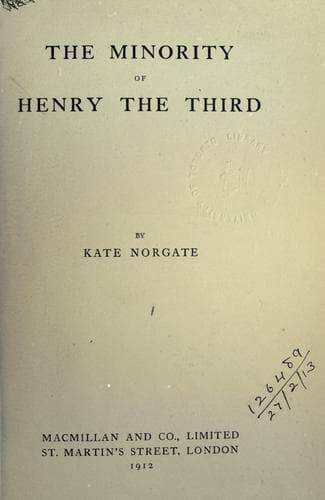
Great Britain -- History -- Henry III, 1216-1272; Henry III, King of England, 1207-1272
never absent from the minds of Henry’s counsellors in their dealings
with his transmarine dominions.
Besides Poitou and Gascony, the Duchy of Aquitaine included four
counties whose rulers owed homage and obedience to the Duke as their
suzerain: Angoulême, La Marche, Limoges, and Périgord. Two of these
stood, during the early years of the thirteenth century, in relations
to each other and to their common overlord which gave them a special
importance in the politics of the Duchy. The county of Angoulême was
the heritage of Queen Isabel, John’s wife and Henry’s mother. La Marche
belonged to Hugh of Lusignan, to whose eldest son Isabel had been
betrothed in her infancy, under whose care she had been brought up,
and from whose house her own father had literally stolen her, a child
scarce twelve years old, {1200} to marry her to the King of England.
Between the houses of Lusignan and of Anjou there was already, even
at that date, a smouldering feud of some years’ standing, which this
outrage, of course, aggravated, but which was allayed for a time in
1214 by John’s promise of little Joan, his eldest daughter by Isabel
of Angoulême, as wife to the younger Hugh in her mother’s stead. Joan
was then four years old. Her bridegroom--known simply as “Hugh of
Lusignan,” his father being Hugh, Count of La Marche--was a young man
in the prime of life,[621] gifted with an ample share of the stirring,
ambitious, acquisitive spirit which characterized his race. That
race was famous alike in legend and in history, and had reached the
height of its greatness within the lifetime of the reigning count of La
Marche, two of whose brothers had been crowned and anointed Kings.[622]
Another brother, Ralf, was in right of his wife count of Eu in Normandy
and owner of some lands in England. In 1218 the elder Hugh went to the
Crusade; and thus when Geoffrey de Neville took up the government of
Poitou and Gascony, the younger Hugh was for practical purposes count
of La Marche, and the most important personage in northern Aquitaine.
He and Joan were still only betrothed, not married; but she was in his
custody, and he was officially treated as “brother” to King Henry; he
had claims against the English Crown respecting certain lands which
John had promised to him at his betrothal;[623] and when his uncle Ralf
of Eu died childless in the spring of 1219, he seems to have also--no
doubt on behalf of his father--laid claim to Ralf’s estates, and taken
a high-handed method of enforcing his demand, by picking a quarrel with
the King’s town of Niort. Geoffrey de Neville tried to mediate, and
promised to procure him satisfaction for any complaint that he might
have against the town, “but,” writes Geoffrey to the King, “he answered
that he would not cease from infesting your land for us or for anybody
else.” Geoffrey had now been seneschal for a year, and was confessedly
at his wit’s end and eager to be rid of an office in which he foresaw
nothing but failure and disgrace.
Public-domain text, read in full here on John Shaqi.
Reviews
Reviews
No reviews yet
Be the first to share your thoughts on this work.
Elsewhere in the archive
Join the Discussion
Join the discussion
Sign in to leave a comment or review.
Sign InorCreate an account