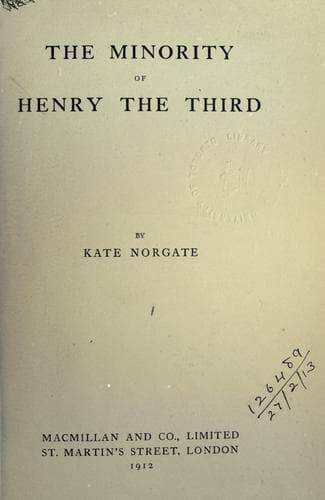
Great Britain -- History -- Henry III, 1216-1272; Henry III, King of England, 1207-1272
It is difficult to define precisely the composition, during the
minority of Henry III, of the body known as the King’s Council. That
body included, besides the Primate of all England, the justices, and
the great officers of State--justiciar, chancellor, treasurer,--certain
persons who were called to be members of it on personal rather than
official grounds, such as Bishop Peter of Winchester, Philip d’Aubigné,
the Earl of Chester, and the King’s uncle, Earl William of Salisbury.
Since the spring of 1219 the most onerous and important part of the
work of government had been shared, under Pandulf, between Hubert de
Burgh and Peter des Roches; Hubert, as Justiciar, naturally taking
the more prominent part. Among our materials for the history of the
time we find no suggestion anywhere that they were other than true
yoke-fellows, till at Whitsuntide, 1221, there occurred the mysterious
affair of Peter de Maulay.[822] The only two chroniclers who record De
Maulay’s arrest say nothing more about its grounds than that he was
“accused of treason.” Falkes de Bréauté, four years later, asserted
that Peter de Maulay after dining at court was called into the King’s
chamber as if for some private discourse, and there denounced as a
traitor who had made a compact with the King of France to deliver into
his hands the Lady Eleanor of Brittany, Henry’s cousin, who had been a
State prisoner in Corfe castle for many years; moreover, according to
Falkes, a greater personage than the castellan of Corfe was involved in
the accusation; it was asserted that a ship to convey the lady over sea
had been made ready by the Bishop of Winchester, who at the time of the
arrest was absent from England on a pilgrimage to Compostella, and that
the bishop was really gone not to pay his devotions to S. James, but to
talk over the plot with Philip Augustus. Falkes declared that the only
real plotters in the case were the Justiciar and his “accomplices,” who
for their own private ends had planned the arrest of Peter de Maulay
in the absence of Peter des Roches, and invented this story against
both; and he adds that they overwhelmed De Maulay with insults, blows,
and other indignities, and loaded him with chains, before they cast
him into prison.[823] Falkes’s story is almost certainly correct thus
far, that no real plot existed; for, whatever ill-treatment Peter de
Maulay may have undergone at the time of his arrest, his innocence
was implicitly acknowledged within less than a week, by his release
as soon as he had surrendered Corfe; and the accusation against the
other Peter, if ever really made, was clearly dropped at once and never
revived. The whole plot seems to have been a sheer fiction; but we can
hardly accept Falkes’s account of its origin. Hubert and Peter des
Roches may have been jealous of each other; and they may have differed
on some questions of policy--perhaps, amongst other things, as to the
expediency or the justice of requiring compliance with the letter of
Public-domain text, read in full here on John Shaqi.
Reviews
Reviews
No reviews yet
Be the first to share your thoughts on this work.
Elsewhere in the archive
Join the Discussion
Join the discussion
Sign in to leave a comment or review.
Sign InorCreate an account